Why Multi-Jurisdiction Benefits Compliance Scales With Automation Not Headcount
Each new state adds interactions, and only automation absorbs them.

Automated benefits compliance monitoring across a multi-jurisdiction workforce connects regulatory changes, payroll validation, benefits triggers, and audit evidence in one continuous process. It scales because each new state extends shared controls. As jurisdictions interact, automation absorbs the compounding work without requiring a matching increase in staff time.
Why compliance obligations compound rather than multiply when companies add states
A single remote hire in a state where the company has never operated creates an immediate compliance obligation. There is no minimum headcount threshold for that trigger. The employer must register separately in the state’s withholding tax and unemployment insurance systems, using two portals with distinct logins and forms. Those registrations are only the entry point. The new jurisdiction also brings rules that must be reconciled with the company’s existing payroll, leave, and benefits policies.
Conflicting leave policies, different definitions of “employee,” and local ordinances layered over state rules create interactions across the existing obligation set. A fifth or tenth state therefore does not simply repeat the work of adding the second. It expands the relationships that compliance staff must understand. Thomson Reuters’ 2026 white paper on multi-jurisdictional compliance describes this position as managing “enterprise-level expectations with mid-market resources,” typically with just two to five professionals per compliance function.
Where fragmented, manual compliance programs visibly break down at scale
The usual failure is drift. A rule changes, but the spreadsheet or inbox thread that records it does not. Legal, payroll, and benefits teams then work from different fragments of the obligation picture, without a shared data layer to reconcile them. Evidence also becomes inconsistent because team members collect it differently across jurisdictions. A periodic review can reconstruct the last checkpoint, but it cannot establish what changed between checkpoints.
The same white paper found that more than half of fast-growing companies often lack the context needed to complete cross-functional compliance tasks. Nearly half have no way to keep a cross-functional view of data up to date. Thomson Reuters’ 2026 commissioned research found that 55% of organizations waste excessive time tracking requests from different platforms. Each additional jurisdiction adds independent filings, deadlines, and portals to that coordination burden.
A hiring team may have a qualified candidate ready to join, yet the company declines to hire because registering in that candidate’s state is too complex. The constraint is no longer confined to administration. Compliance now shapes where the business can hire, as the system reaches the limits of the smaller geographic area it was built to cover.
What automation actually does that adding compliance staff cannot
An additional compliance professional can absorb a fixed amount of review, reconciliation, and follow-up. That does not change how the work grows. If each jurisdiction still requires a separate monitoring process and evidence collection exercise, every hire joins the same expanding coordination problem. Automation changes the architecture instead. A new state maps into shared controls, allowing the organization to extend existing processes.
The distinction is temporal as well as organizational. Manual compliance is retrospective, assessing whether the employer was compliant at its last check. Continuous monitoring catches drift as it happens, before a filing deadline or enforcement action brings it to light. Regulatory alerts replace periodic searches, while integrated evidence collection replaces emailed requests and end-of-period collation. Control mapping also shows where obligations overlap and where one policy or filing can meet more than one requirement.
Payroll processing follows the same logic across jurisdictions. Filings are validated against live rate tables and submitted through agency APIs, removing the manual rekeying between payroll outputs and agency systems. People still have issues to resolve, but the system no longer depends on their rebuilding the whole compliance picture before each deadline. This is the structural basis for the white paper’s description of compliance as a “critical growth enabler.” Expansion becomes an extension of the control environment rather than another independent administrative operation.
The penalty architecture of ACA, ERISA, COBRA, and Form 5500 that makes manual monitoring indefensible
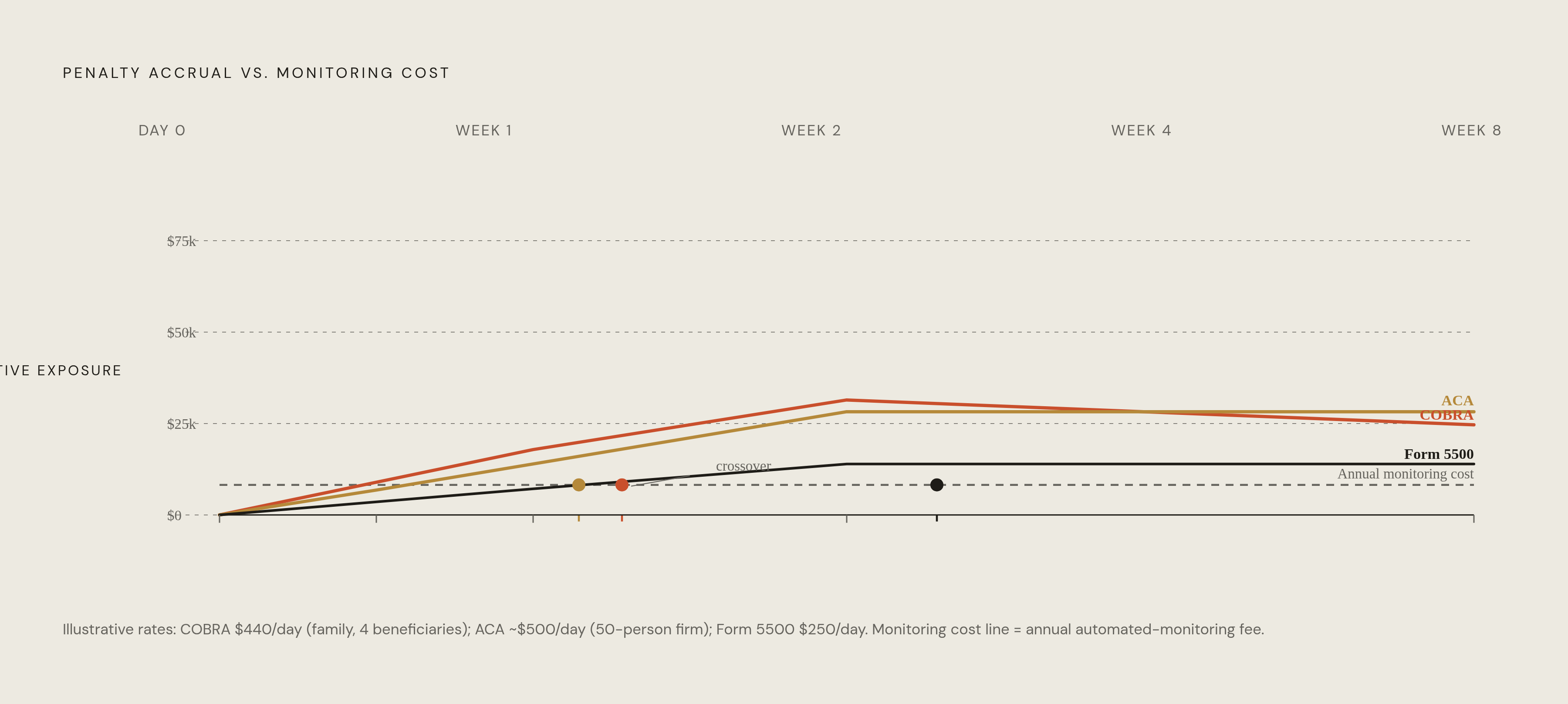
Form 5500 late-filing exposure includes a DOL civil penalty that accrues daily without a cap until the filing is submitted. ACA penalties for failure to offer minimum essential coverage can reach thousands of dollars per full-time employee annually. COBRA exposure attaches to each missed or defective notice through a per-day penalty per qualified beneficiary. When a notice failure affects a family, those penalties can reach six figures annually.
These schedules turn elapsed time into financial exposure. Depending on the failure, penalty accrual can exceed the annual cost of automated monitoring within days or weeks. The cost comparison includes what the software costs and what the staff costs. It includes how long an error can remain undiscovered under each operating model.
Enforcement is also moving toward these benefit obligations. The DOL’s 2026 national enforcement projects expressly moved resources toward health and welfare plan compliance, which had received less scrutiny in the past. Most mid-sized employers have never faced a DOL audit of their health and welfare plan. ERISA litigation is also widening into mid-sized plans, aided by plaintiffs’ firms using AI-driven discovery tools to identify opaque or incomplete filings.
How the obligation set intensifies specifically for multi-state tech employers in the current regulatory environment
The 2026 environment adds several obligation categories at once. Many states raised minimum wages on January 1, 2026, so payroll had to be updated in all affected jurisdictions at the same time. For a distributed employer, that is not a single company-wide rate change. Each affected jurisdiction requires the correct update within an operation that must still administer every other state’s rules. The work of keeping these rules in step grows even when the workforce stays the same size.
New paid family and medical leave programs deepen that interaction. Several programs launched in 2026 with distinct eligibility rules, contribution structures, and employer notice obligations. These requirements must be reconciled with the employer’s established approach across its other jurisdictions.
Pay transparency adds another dimension to the same problem. State requirements differ over what must be disclosed, to whom, and in what format, so the compliance surface varies by posting location as well as employee location. A tech company with engineers across a dozen states faces a benefits and payroll compliance surface in 2026 that did not fully exist in 2023. The regulatory environment has expanded around the company, independently of its own growth.
How do you keep benefits compliance up to date automatically across multiple states?
Continuous monitoring is a connected operating process. A compliance team member receives a real-time alert when a state changes a wage floor, launches a leave program, or modifies a filing requirement. That replaces the manual review that can miss changes between audit cycles. The resulting work is specific, such as a jurisdiction rate change requiring a system update or a filing that is overdue.
Employee events also initiate the relevant benefits workflows. When an employee is terminated, a COBRA notice workflow starts automatically. When the plan year ends, ACA reporting pulls from payroll data rather than requiring manual extraction and reconciliation. Payroll filings are validated against current jurisdiction-specific rate tables before submission. These connections cut out repeated handoffs between people and systems where errors can slip in.
Evidence is generated as the work takes place. Each notice sent, filing submitted, and rate table applied is recorded with a timestamp and an evidence link. A team member preparing for an examination can therefore work from an existing audit trail rather than assemble one from inboxes and shared drives. The white paper calls this shift “fragmented to frictionless.”
Why benefits plan design and benchmarking belong inside the same automated infrastructure as compliance
Claims data, workforce demographics, and carrier pricing can also support plan analysis, revealing the gap between what an employer pays and what the market offers. When that analysis is kept apart from compliance, related decisions rely on different information and people must do renewal work by hand. Automated compliance infrastructure captures only part of its potential when plan design remains detached from it.
Healthcare costs rise each year, so keeping a plan without renegotiation means paying more for it. An insufficient negotiation also leaves the next renewal starting from a higher cost base than it should. Annual benchmarking connects each renewal to workforce utilization and current carrier pricing rather than treating the prior plan as an adequate reference point.
Traditional commission structures can limit the incentive for aggressive renegotiation, particularly when mid-market premium volume does not justify the relationship overhead. An AI-native brokerage model is also paid by carrier commission and is free to the employer, but applies automated plan analysis at every renewal. Its distinction is the operating process. That model uses the same data infrastructure for carrier benchmarking, with no added per-employee fees or co-employment structure.
How to evaluate whether your current compliance and benefits setup can absorb the next state you hire into
The practical assessment is whether the current setup can absorb another jurisdiction without a proportional increase in staff time, error rate, or penalty exposure. To test the operating model, an employer should establish how a minimum wage, paid leave contribution rate, or filing deadline change reaches the person responsible for payroll within that pay cycle. It should also establish what triggers a COBRA notice after a termination and how evidence of timely delivery is preserved. These questions distinguish a continuous process from one that depends on someone remembering to act.
Plan design and market entry provide two further tests. When was the plan last benchmarked against current carrier pricing and actual workforce utilization? If a qualified candidate accepts an offer in a state with no existing payroll registration, how long will it take to be legally ready for the first paycheck? Operators should be able to answer both questions immediately. Uncertainty exposes a gap between the company’s growth ambitions and the infrastructure supporting them.
The transition becomes particularly important when exiting a PEO or outgrowing a legacy broker relationship. Those changes remove whatever compliance backstop the prior arrangement provided. The appropriate alternative is not to reconstruct that support manually, but to move toward continuous automated monitoring, carrier negotiation, and employee support on top of existing HRIS tools. The AI-native brokerage model provides a benchmark for that comparison without co-employment or per-employee fees. Its defining properties are continuous regulatory monitoring, benchmarking at every renewal, and automatically generated compliance evidence.
The greatest exposure often belongs to a company whose setup was correct for a smaller, simpler version of itself and remained in place as jurisdictions and obligations accumulated. More staff can keep that arrangement functioning longer. They cannot change the way its work compounds.