Aligned-Incentive Brokerage Models and What They Deliver Differently
Transparent broker fees deliver 2-4 percentage points lower renewal increases than commissions.

Most benefits brokers get paid a cut of the premium a carrier charges the employer. The broker's income rises when the employer's costs rise. That single fact shapes almost everything else in this piece: how renewals get handled, how plans get designed, and what employees end up paying out of pocket. Aligned-Incentive Brokerage Models and What They Deliver Differently.
The structural conflict in commission-based brokerage
NAHU's 2025 Broker Survey found about 72% of brokers serving mid-size employers still work this way, taking a commission from the carrier that gets folded into the premium rate. The employer never cuts the broker a check, so the arrangement looks costless. The arrangement looks costless, but it is not. Because the fee sits inside the premium, the broker earns more in a year when costs go up than in a year when they don't, and nothing in the compensation structure rewards the opposite outcome.
That math appears in how slowly things move. A market review on the traditional timeline runs 8 to 12 weeks, long enough that plenty of employers just let the renewal roll over rather than push through a full re-shop 5 Top Benefits Brokers of 2026: Compare the Best Firms. Plan design gets set once and left alone: no yearly renegotiation, no benchmarking against what similar employers pay, no real pressure on the carrier to defend its number. None of this requires a broker acting in bad faith. It's a feature of how the incentive is built.
The industry is starting to name this out loud. Selerix's 2026 read on the market is that clients no longer want someone to simply place coverage, they want someone who can read the trend lines, stress-test a renewal strategy, and build a plan that still makes sense a year out. That's a real shift, from benefits seller to benefits strategist, and it only makes sense in a model where the broker's paycheck doesn't depend on the employer paying more.
What "aligned incentives" means in a brokerage contract
An aligned-incentive contract flips the default: compensation is fixed, disclosed up front, and doesn't move based on which carrier or which plan tier the employer picks. There's no premium-linked upside sitting quietly inside the fee.
Disclosure is what makes the model checkable rather than just claimed. Every dollar the broker earns gets put on the table before the engagement starts, so the employer can look at two competing carrier quotes and know the broker isn't quietly favoring the one that pays a fatter commission. Fee-based arrangements and commission arrangements that fully disclose their numbers can both count as aligned, so long as neither one rewards the broker for steering toward the pricier plan. The test isn't the payment mechanism, it's the direction of the incentive.
Once that's true, the broker's financial interest in any particular carrier disappears, and speed turns into a selling point instead of a corner cut. Ignition Benefits reports that the same depth of market review that takes a traditional broker 8 to 12 weeks can run in 14 to 21 days under an aligned model 5 Top Benefits Brokers of 2026: Compare the Best Firms. Annual renegotiation becomes the standard operating procedure rather than a special request.
The measurable gap between aligned and commission brokers at renewal
Analysis from businessinsurance.health shows employers working with fee-based, transparent brokers see renewal increases that run 2 to 4 percentage points below employers stuck with opaque, commission-driven ones Benefits Broker Compensation Analysis: Commission Structures and Cost…. On its own, 2 to 4 points sounds like rounding error https://www.beckershospitalreview.com/legal-regulatory-issues/how-health-insurers-steer-employer-benefit-decisions-with-broker-bonuses/. It isn't, once it's stacked against three consecutive renewal cycles and a market where costs are already climbing fast.
And the baseline is not gentle. Aon projects a 9.5% rise in employer healthcare costs for 2026, the third year running of near-double-digit increases with no sign of relief. Business Group on Health calls the 2026 median forecast of 9% the highest single-year jump in more than a decade.
What's likely driving the gap is behavior. A broker with nothing to gain from a higher premium negotiates harder, recommends plan changes it might otherwise soft-pedal, and defers less to whatever the carrier proposed last year. None of this comes from a controlled experiment, and other factors at the firm level surely play a role too. But the direction of the data lines up cleanly with the incentive logic: remove the reward for inertia, and inertia goes down.
How an aligned broker approaches plan design and carrier negotiation
For an aligned broker, benchmarking every renewal against the market isn't an add-on service, it's just what the job requires, since there's no financial downside to comparison shopping. GTM Hub's 2026 read on open enrollment trends found employers who get real benchmarking data from their broker end up in a much stronger spot to manage cost growth without simply passing the increase along to employees.
Scale matters here too. Aon draws on $650 billion in claims data to advise employers on carrier discounts, network coverage, and provider access, which is a useful illustration of how analytical depth turns into actual negotiating leverage at the table. An aligned broker without that scale still applies the same logic at a smaller size: network tier restructuring, closer scrutiny of high-cost claims and specialty drug spend, and active use of the levers regulators hand employers each year.
Some of those levers are easy to miss if nobody's looking for them. EBHRA contribution limits rose to $2,200 for 2026, up from $2,150, a design tool a commission-paid broker has little reason to flag since it doesn't touch their compensation either way. Mercer's employer survey, reported by SHRM, puts average per-employee health benefit spend past $18,500 for 2026, a figure that makes even modest plan design improvements worth real dollars. ACA affordability threshold management sees the IRS raising the affordability percentage to 9.96% for plan years beginning in 2026, up from 9.02% in 2025, creating room to adjust employee contribution levels while remaining compliant Benefits Broker Compensation Analysis: Commission Structures and Cost…. Speed functions as a structural output: a 14–21 day turnaround on market reviews means plan design conversations happen early enough to act on, not after the renewal window has closed 5 Top Benefits Brokers of 2026: Compare the Best Firms.
What employees experience when their employer's broker is optimizing
Under the old model, the employee experience is usually a PDF and an 800 number. Benefits literacy support rarely gets built into the service, because it doesn't move the broker's paycheck one way or the other.
That gap is landing harder every year. Mercer found payroll deductions for health coverage could rise 6.5% on average for 2026, the steepest jump in 15 years. KFF reports the average marketplace deductible grew by roughly $1,000 per person in 2026, as enhanced tax credits expired and more people shifted into higher-deductible plans. When deductibles and paycheck deductions both climb at once, an employee who doesn't understand their plan is the one most likely to skip care they need or get blindsided by a bill.
Aligned-model firms tend to build support differently, offering real-time help rather than a wall of silence that lifts only during open enrollment. MetLife's 2025 U.S. Employee Benefit Trends Study found dental coverage tied to stronger employee loyalty, and found Gen Z and millennial workers rank paid leave higher than Gen X employees do. Acting on distinctions like that takes a broker actually looking at workforce data, not one working off a template. The payoff loops back to the employer directly: employees who understand their benefits and actually use them tend to stay longer, and an aligned broker has a real reason to make sure that happens, because keeping the client depends on demonstrated value, not on commission flow.
How AI changes broker capacity in the aligned-incentive model
Market reviews on a traditional timeline take 8–12 weeks, slow enough that many renewals simply roll over 5 Top Benefits Brokers of 2026: Compare the Best Firms. Vertafore reports that extraction used to eat up to 45 minutes per plan and now runs about a minute with AI doing the work, more accurately than the manual process did.
That reclaimed time changes what's possible, not just what's fast. Cost projections in the 6 to 9% range appear by early summer, and a broker running AI-backed analysis can start shaping carrier strategy months before the renewal window ever closes. Quotes get grounded in a client's actual claims data instead of an actuarial average pulled from a generic book of business. And cost drivers, specialty medications, a handful of high-cost claimants, get flagged before they compound into next year's renewal shock.
AI is turning into compliance infrastructure too, tracking obligations across jurisdictions that a commission broker rarely bothers to prioritize since none of it adds to revenue: multi-state paid family and medical leave rules (13 states plus DC now run programs, with Delaware, Maine, and Maryland each at a different stage of rollout as of 2026), ACA affordability recalculations, ERISA filing deadlines. PWC's actuarial survey puts medical cost trend at 8.5% for the group market in 2026, which is the environment that makes analytical precision, not a relationship built on habit, the standard an employer should expect. None of this replaces the strategic judgment a good broker brings. What it removes is the manual drag that used to keep an aligned broker from actually delivering on the promise the structure makes.
The PEO comparison: why co-employment adds a second layer of misalignment
Startups turn to PEOs for a reason: roughly one in three companies faces compliance penalties in its first three years, and a PEO removes much of that early risk. NAPEO data puts average client ROI at 27%, with 10 to 14% lower turnover and a 50% lower chance of the business shutting down.
The cost math turns against the employer as the company grows. PEOs typically charge 2 to 12% of total payroll, or $40 to $160 per employee per month https://wise.com/us/blog/peo-pricing.
There's a control problem sitting underneath the cost problem. PEOs co-employ the workforce, hold the benefits data, and file taxes under their own EIN. The employer's negotiating leverage and market intelligence live inside someone else's system, not unlike a commission broker who sits on carrier relationships and won't hand over benchmarking data. Leaving isn't free of risk either. A 2025 claim report cited by PEOMetrics found 18% of mid-sized employers exiting a PEO hit temporary gaps in workers' comp coverage averaging $42,000 in uncovered liability per incident, and COBRA administration costs often spike 30 to 50% after exit because the process turns manual again PEO Exit Strategy: A Step-by-Step Playbook for 2026. Companies in the 25-to-200-employee range facing rising benefits costs are exactly the group where a structured exit, paired with an aligned-incentive broker, produces the clearest return. It's landing somewhere the incentives and the expertise both actually sit on the employer's side. PEOs charge 2–12% of total payroll, or $40–$160 per employee per month, meaning that for a 20-person team at $100K average salaries, that amounts to $60K–$300K annually in fees alone.
What to look for and ask when evaluating a broker's alignment
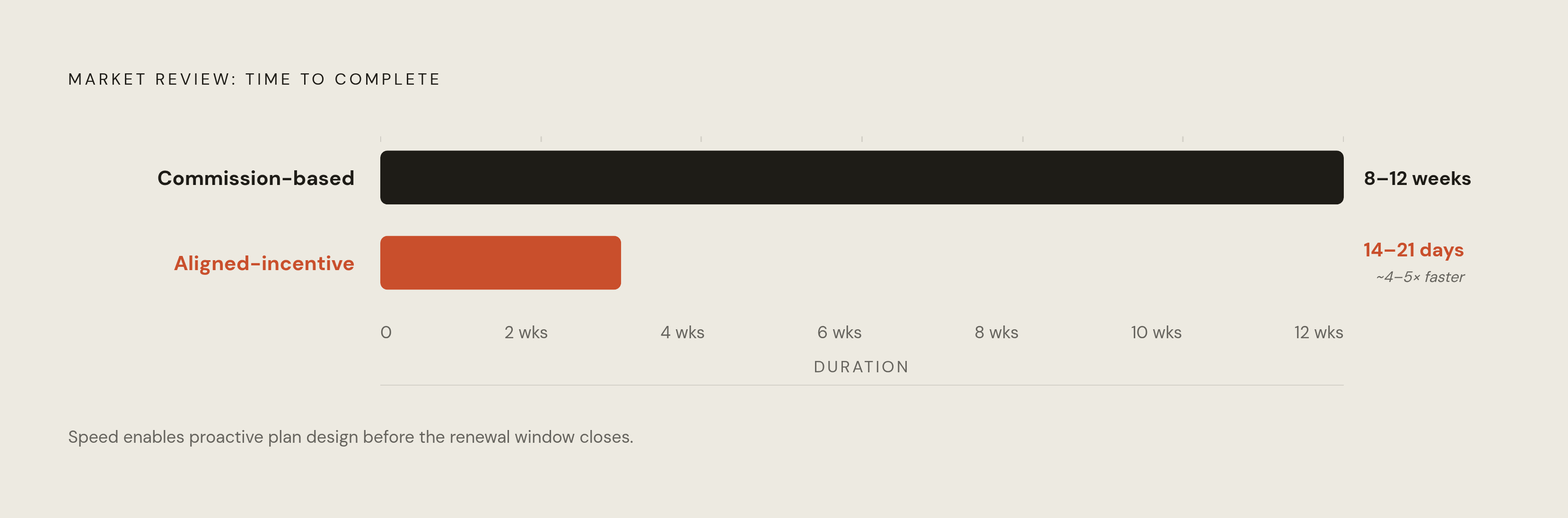
Ask for a full accounting of compensation, from every carrier, for every product, before signing anything. A broker that's genuinely aligned hands this over without hesitation. Ask how many clients had their plan or carrier changed at last year's renewal; a commission broker's answer to this question tends to say more than anything in the pitch deck. Ask how long a full market review takes: 8 to 12 weeks reveals a manual, relationship-driven process, while 14 to 21 days reveals real analytical infrastructure built into the service.
Ask whether the broker delivers peer benchmarking data on plan design, contributions, and carrier pricing, or whether the only numbers on the table came from the incumbent carrier itself. Ask whether compliance issues, ACA affordability thresholds, state-by-state PFML obligations, ERISA filing deadlines, get flagged proactively, or whether they become visible only after the fact, once already a problem.
A newer category of AI-native, aligned-incentive brokerage is emerging that answers all of these questions at once, layering plan analysis, compliance monitoring, and real-time employee support directly on top of a company's existing HRIS, often at no direct cost to the employer. For tech companies in the 25-to-200-employee range that have outgrown a PEO or are starting to question their current broker relationship, it's a credible option worth putting on the list. At a baseline of 9 to 9.5% annual cost growth, the choice between an aligned broker and a commission broker is a compounding financial decision, not a matter of taste or service style. It's a compounding financial decision, made once a year, that either works for the employer or quietly works against it.
Sources
- Key employee benefits trends shaping 2026 for brokers | Vertafore
- 10 Best Benefits for 2026 | Selerix
- 5 Top Benefits Brokers of 2026: Compare the Best Firms
- Benefits Broker Compensation Analysis: Commission Structures and Cost Impact
- PEO Exit Strategy: A Step-by-Step Playbook for 2026
- How health insurers steer employer benefit decisions with broker bonuses - Becker's Hospital Review | Healthcare News & Analysis