The Regulatory Feed Problem Behind Jurisdiction Change Detection in Benefits Platforms
Benefits compliance fails upstream, where feeds miss work moves.
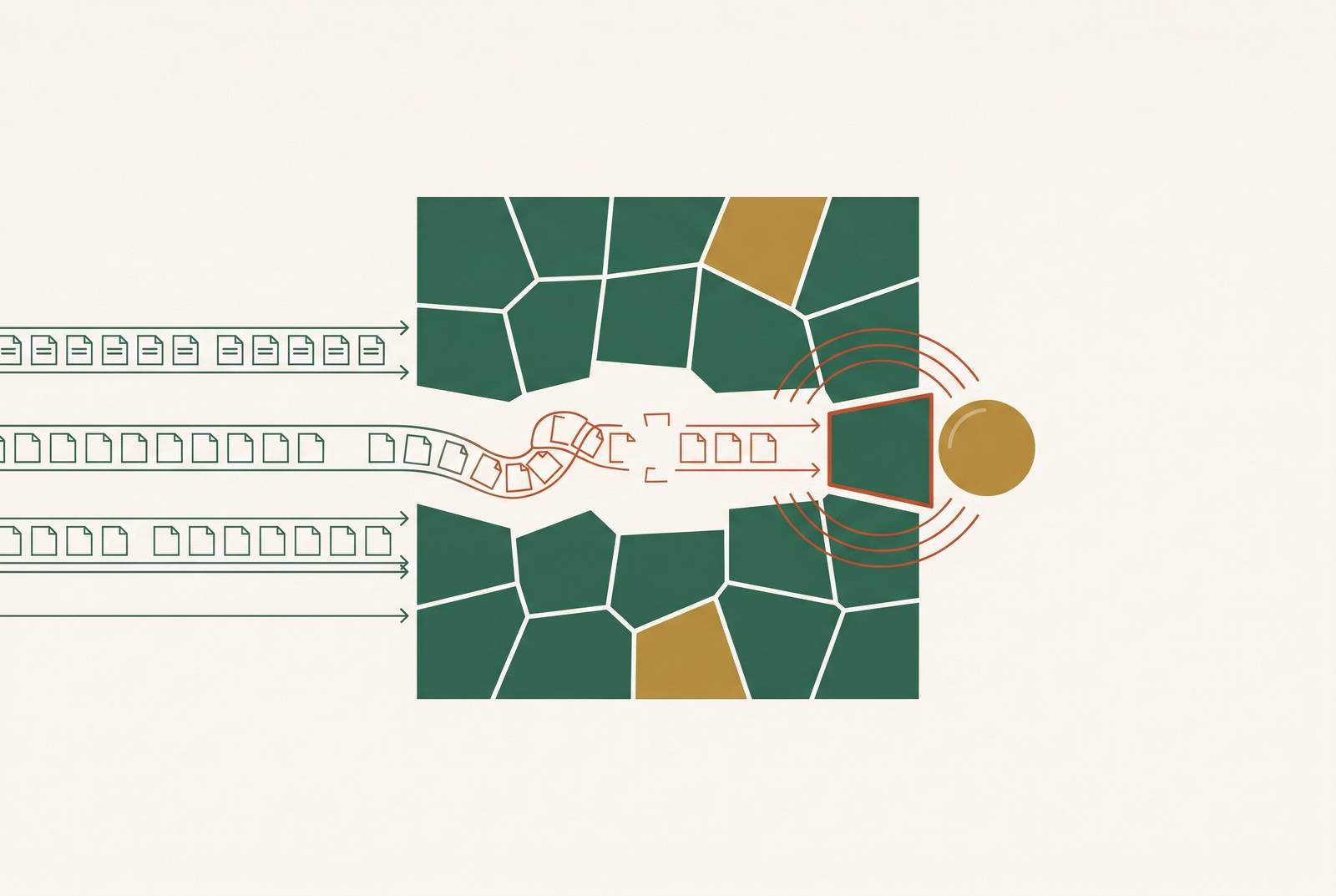
Automated benefits compliance monitoring for a multi-jurisdiction workforce needs continuous primary-source monitoring linked directly to employee records. The main gap is upstream of the rules engine, in the feed layer that determines which jurisdictions and requirements apply to each employee. Closing that gap takes more than a software patch: regulatory changes, work-location events, and processing systems must be linked.
Why jurisdiction detection is the first step in multi-state benefits compliance — and why it breaks
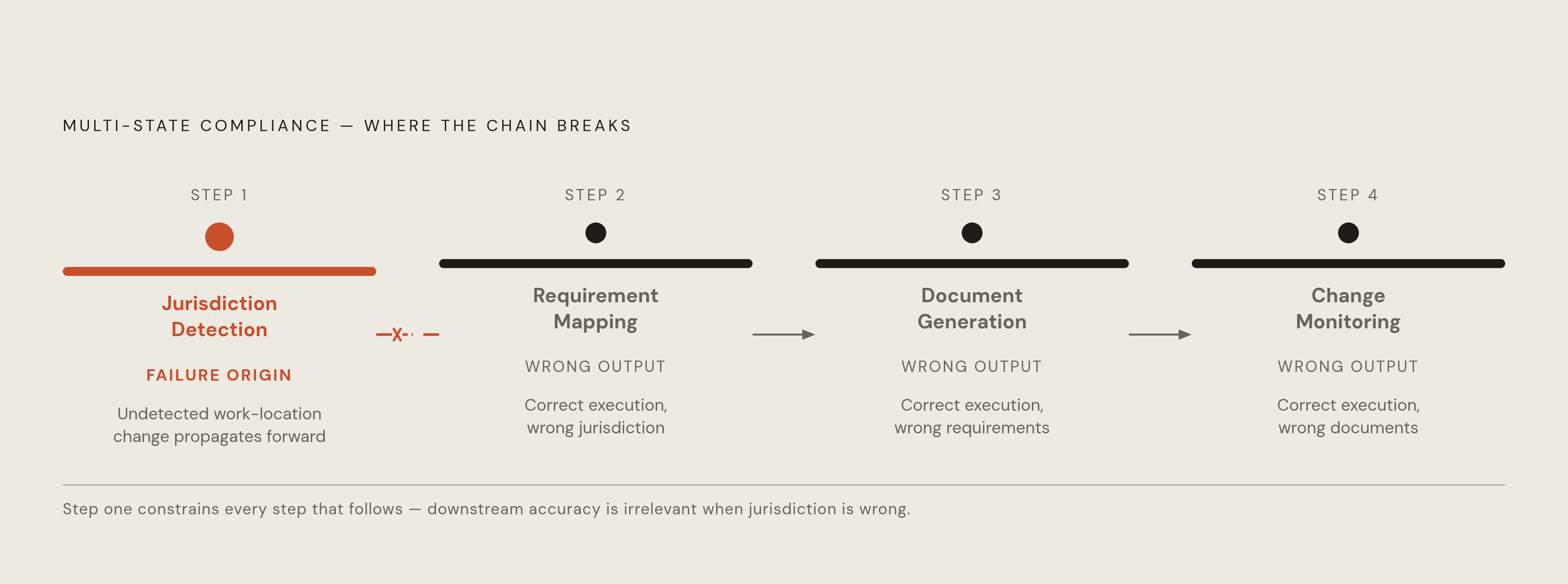
Benefits platforms market rules engines, compliance libraries, and automated obligation mapping as the machinery of multi-state compliance. The system must first know which jurisdictions apply to each employee. A rules engine can apply a requirement correctly and still produce the wrong result if the employee has been assigned to the wrong jurisdiction. The advertised capability therefore sits downstream of the point where compliance can first fail.
Multi-state benefits compliance follows a chain of jurisdiction detection, requirement mapping, document generation, and change monitoring. The first step constrains every step that follows. If a work-location change goes undetected, the platform lacks the input needed to select the applicable requirements or generate the corresponding documents. Updating the compliance library does not resolve that omission, because a current rule still needs to be matched to the employee it governs.
The trigger is where the employee performs work. Every remote hire, relocation, and temporary work arrangement can therefore be a jurisdiction-change event. A platform must connect what changes in the workforce with what changes in the law before it can map obligations reliably. The weakness is not a missing rule but a missing connection between those two sources of change.
What payroll compliance law actually says about where obligations attach
Payroll compliance follows where an employee physically performs work. Obligations can begin on the first day of work in a new state. Payroll tax nexus has a zero-dollar threshold, which sets it apart from sales tax nexus. Even one remote employee in a state where the company is not registered as an employer can trigger full obligations.
A single new-state hire creates obligations across at least six functional areas, including tax registration, unemployment insurance, wage and hour rules, leave entitlements, required notices, and often a mandatory paid leave contribution program. These obligations apply concurrently. An existing employee’s relocation can similarly affect tax setup, state-mandated benefits, paid leave, disability insurance, required notices, handbook content, and health plan network access.
Temporary work can trigger obligations as well. In 22 states, even a single day of work can trigger filing obligations, so the system must also track business travel and temporary assignments. The legal significance attaches to the work itself, so a system that recognizes only a lasting change of residence can miss a relevant event.
How the regulatory feed layer is actually built — and where it breaks down
Regulatory changes do not arrive on one predictable schedule. Minimum wage changes make this scheduling problem concrete. Many states change their rates in January, while others do so mid-year. A platform that syncs its rate tables only once annually after January 1 is structurally exposed to violations later in the year.
The sources are uneven as well as unsynchronized. Operationally significant changes often appear in guidance documents, FAQ updates, and staff bulletins rather than the Federal Register or formal rulemaking. The Trump administration’s 2019 catalogue of federal guidance documents found more than 73,000 that had never gone through formal rulemaking, illustrating “regulatory dark matter”. Legal research platforms reliably index statutes and case law, but they do not systematically cover the agency guidance pages and informal publications where many actionable changes first appear.
Regulatory monitoring has two distinct sourcing architectures. Curated content feeds license and sum up news of regulatory events and provide structured metadata, but updates may take days to arrive. Source-level web monitoring watches regulator pages directly and can catch changes on the day they occur, but the organization must define its own source list. Neither approach removes every coverage problem. The strongest programs layer an aggregator for well-covered major regulators with direct monitoring for the long tail the aggregator misses.
In a benefits platform, however, finding a change is only part of the task. The feed must also connect to individual employee records. When a work-state change is logged, withholding, unemployment insurance jurisdiction, leave eligibility, and state-specific requirements must all be updated together. This is where many platforms break, because the feed exists without a real-time connection to the employee record.
The employee-record event that should trigger detection — and usually does not
A mid-pay-period state change exposes the failure clearly. The platform must calculate the initial days under the previous jurisdiction’s rules and apply the new state’s withholding requirements to the remainder. The relocation date is the dividing line. Most platforms do not perform this proration in real time, leaving a gap between the recorded move and the calculation that should follow it. An address can be current while the processing logic remains behind.
That gap can affect federal tax treatment as well. Paying state unemployment insurance contributions to the wrong state can affect FUTA credit eligibility, and incorrect payments may cost an employer some or all of the 5.4% FUTA credit under the standard federal unemployment tax schedule. The financial consequence compounds quarterly and is difficult to unwind retroactively. The IRS requires employers that paid FUTA taxable wages in more than one state to file Schedule A (Form 940). A missed jurisdiction event can therefore become a federal reporting error.
At the HRIS event, an address change is typically processed as a payroll data update rather than a compliance trigger that initiates changes across systems. For a cross-border remote hire, the necessary validation extends beyond standard onboarding to at least six fields, namely work state, work address, tax ID format, state-specific withholding elections, right-to-work verification, and expected travel pattern. Missing information can cause problems over more pay periods as processing goes on without the inputs needed to get the treatment right.
Why the feed problem is harder to see inside a PEO relationship
Inside a PEO relationship, jurisdiction detection is the PEO’s operational responsibility. The employer may therefore never build its own detection and response infrastructure. That dependence can remain out of view.
A PEO exit makes the missing infrastructure more consequential. Claims data for health, workers’ comp, and unemployment have lived under the PEO’s tax ID, so the exiting employer may lack the history needed to understand its multi-state compliance footprint. The same absence can weaken its knowledge when negotiating carrier rates. Historical data is part of the capability gap. A regulatory feed on its own cannot provide the employer’s record of the obligations and experience built up under the prior arrangement.
Companies inside a PEO frequently do not file a standalone Form 5500 because the arrangement absorbs the obligation, leaving that compliance process unbuilt internally. Employers sponsoring group health and welfare plans governed by federal employee benefits law with at least 100 plan participants at the start of the plan year must file. The return is due seven months after the plan year ends, or July 31 for calendar-year plans. PEO dependence can thus allow a company to reach meaningful headcount without developing either the detection layer or the internal reporting processes it will need outside that relationship.
A specific benefits-layer variant: when the plan document diverges from the operative rule
A plan’s Summary of Benefits and Coverage may describe one cost-sharing structure while the insurer’s filed plan design has very different requirements. The platform can ingest the summary accurately and still analyze the wrong terms. Accuracy of extraction is not authority of source. The system treats a secondary description as though it were the operative rule.
Timing adds another source of divergence. Health plans update benefits, reimbursement terms, and clinical coverage policies mid-year, so the document ingested at enrollment is not necessarily the plan governing a claim filed six months later. The platform needs access to the operative plan design. Otherwise, the analysis may be internally consistent but disconnected from the requirements that apply.
AI tools applied to plan design inherit this limitation. If their data layer contains the SBC rather than the filed plan design, their analysis may not reflect current, operative plan terms. More capable analysis does not correct an authoritative-source mismatch. The same primary-source principle used for jurisdiction monitoring applies here, with the filed design taking precedence over the summary distributed to employees. Any benefits workflow that relies on a secondary document to represent the governing terms can inherit this source mismatch.
How do you keep benefits compliance up to date automatically across jurisdictions?
Jurisdiction detection must start with alerts on the day a change appears in primary sources, including the actual regulator page, official gazette, or state agency filing. A downstream digest that may lag by days does not meet that standard on its own. Detection must also reach the employee record. The compliance engine must keep querying state and federal regulatory databases, match updated values to the right employee profiles before the next processing cycle, and prorate tax liabilities from the exact relocation date, accounting for the time before the next monthly sync.
Changes come too fast for checks made only from time to time. In 2026 alone, scores of jurisdictions changed their workplace posting requirements. Minnesota’s paid family and medical leave program took effect on January 1, 2026, and allows up to 20 weeks of leave paid for through employer and employee contributions. Minnesota’s official Paid Leave site explains how much leave is allowed in total. The operational requirement was not simply to know that the program existed, but to connect its effective date and contribution requirements to each affected employee.
The 2026 ACA penalty for failing to offer minimum essential coverage to the required threshold of the workforce is $3,340 per full-time employee per year, subject to the 30-employee reduction. That calculation concerns full-time headcount. This calculation shows why employee data must be right to manage coverage obligations, though tracking regulatory changes and identifying the workers they apply to are separate parts of the process. Neither can substitute for the other.
Many HR and payroll vendors describe their products as integrated, but that label does not establish a single database in which the record calculating the paycheck is also the record supporting the tax return and an audit. The decisive comparison is therefore architectural. A curated feed provides structured regulatory content, direct source monitoring tracks selected primary sources as they change, and a real-time link to employee records lets the system apply those changes when it processes those records. An AI-native approach can meet that need by analyzing workforce data and carrier pricing together while keeping those links in place at all times. The solution is not a more elaborate rules engine, but continuous primary-source monitoring connected directly to the employee record.