Twelve-State Benefits Compliance Is an Orchestration Problem Not a Calendar Problem
Continuous regulatory monitoring and location-aware logic replace static annual checklists.
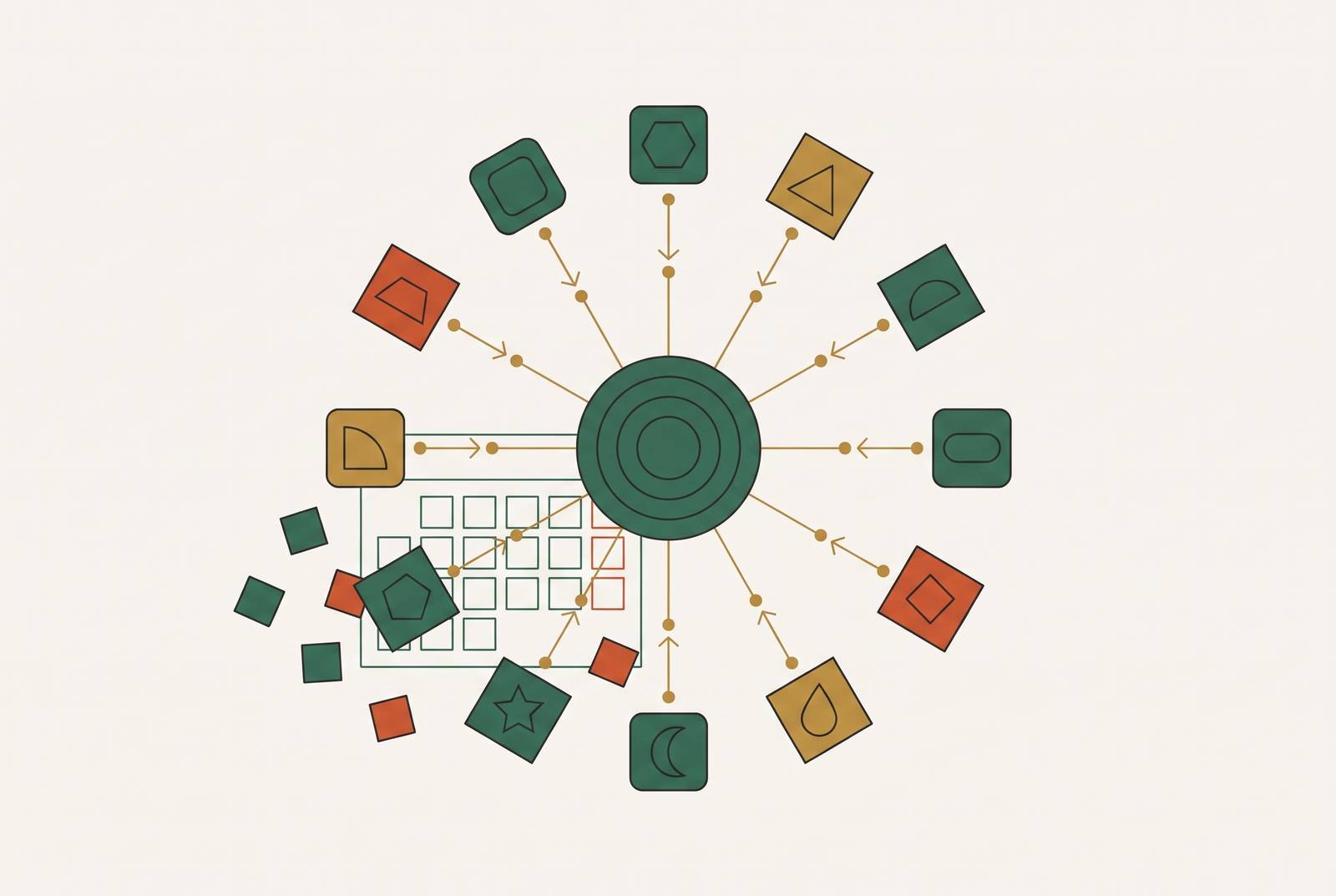
Twelve-state benefits compliance is an orchestration problem, requiring continuous regulatory monitoring, location-aware eligibility logic, and coordination across payroll and benefits. A calendar records known deadlines, but an operating system must also detect new obligations and assign responsibility for acting on them.
Why multi-state compliance keeps failing despite calendar discipline
Compliance work has familiar points in the year: open enrollment, the July 31 Form 5500 deadline, and the January 1 payroll reset. Each is a legitimate planning point. The mistake is treating those points as a complete picture of the employer’s obligations. A company can prepare carefully for all three while missing requirements triggered by a remote hire, a move, or a regulatory change between scheduled reviews.
The failure is in the operating model. Obligations accumulate by employee work location, so expansion changes the compliance workload even when the benefits calendar stays the same. A single remote employee in a new state can trigger payroll tax nexus, SUI registration, and workers’ compensation review simultaneously. Those requirements connect functions that an annual checklist may treat as separate.
The regulatory changes arriving in 2026 intensify that mismatch. New paid leave programs, changes that expand pay data reporting, AI-in-employment-decision rules, and updates to sick leave thresholds are coming at different times. Calendar discipline remains useful, but it cannot identify an obligation that has not yet entered the calendar. The employer needs a way to detect changes before it can schedule the response.
How employee location converts into an immediate cascade of state obligations
New-hire reporting provides a simple example of the problem. Federal law requires reporting within 20 days, but several states allow much less time. A uniform internal process built to the federal standard is therefore already non-compliant in those states. From headquarters, the reporting task looks the same, but the time allowed depends on the jurisdiction.
That same hire can trigger a broader cluster of requirements. Income tax withholding, SUI, local taxes, workers’ compensation, leave, and benefits eligibility each require attention under different rules and timelines. These are not independent administrative chores. SUI contributions affect FUTA credit eligibility, so paying into the wrong state can put some or all of the federal FUTA credit at risk.
Benefits eligibility introduces another dependency because determinations must account for where the employee performs work. A uniform firmwide rule without location-aware logic can produce inconsistent determinations across the workforce. Pay transparency adds rules for the role itself, with state posting rules and more rules at the city and county level. The operational burden is resolving several linked questions about the same employee without assuming that one jurisdiction’s answer applies everywhere.
Why regulations arrive on asynchronous schedules no annual calendar can capture
State rules change outside the federal and plan-year calendars, so even a complete jurisdiction map can fall out of date between annual reviews. A January audit captures a snapshot. If the employer acts on that snapshot through the following December, mid-year changes fall outside its normal decision process.
Four states have enacted portable benefits laws, and nine more introduced bills in early 2026. Alabama’s SB 86 created a state-law evidentiary protection preventing contributions from being used as a criterion for worker classification, together with a double tax advantage for contractor benefit contributions. Federal classification standards remain unchanged. The distinction requires monitoring both what changed and which layer of law the change affects.
Privacy obligations follow another schedule, with state laws differing in applicability thresholds, consumer rights scope, and enforcement timelines. Court decisions can also reshape obligations between legislative cycles. The relevant unit of work is a change requiring action.
What ERISA, ACA, COBRA, and Form 5500 obligations add to an already moving system
The federal benefits layer compounds this asynchrony. ERISA, COBRA, Form 5500, and other federal benefits obligations sit within the same operating environment as state eligibility and payroll requirements. Some duties have set filing dates, while others arise from events or from work that must be done on an ongoing basis. A deadline list captures only part of that workload.
COBRA makes the event-driven requirement especially clear. Its clock starts within days of a qualifying event, so notice and election tracking must be tightly integrated with eligibility and enrollment data. Carriers manage claims, while SPDs and COBRA administration remain the employer’s legal responsibility.
The penalty structure makes delayed detection expensive. The DOL may assess up to $2,739 per day for a late Form 5500 under ERISA Section 502(c)(2), while missing an SPD distribution can trigger a per-participant, per-day fine. The DOL’s EBSA has also put a large share of its enforcement resources into health and welfare plan compliance, with national enforcement projects that focus on cybersecurity, barriers to mental health and substance use disorder benefits, and surprise billing compliance.
How year-end payroll consolidation exposes every gap the calendar model left open
Year-end payroll reconciliation is a diagnostic of the process that preceded it. Registration gaps, withholding errors, and misallocated SUI contributions that escaped attention during the year become simultaneous correction tasks, with penalties already accruing. Each state has its own rules for withholding, unemployment, and filing. All of that must reconcile into one accurate W-2 per employee.
Reciprocal agreements show why consolidation requires more than combining records. Ohio has agreements with Indiana, Kentucky, Michigan, Pennsylvania, and West Virginia, allowing an employee who lives in one of those states and works in Ohio to claim exemption from Ohio withholding. A one-size approach produces errors despite appearing consistent. Contractor reporting adds another distinction because some states require separate 1099 filings and others do not. Portable benefits then add classification complexity to that reporting workload.
The W-2 deadline for 2026 wages falls on February 1, 2027. It does not flex with the reconciliation burden. An employer discovering discrepancies at that point must correct problems that have accumulated since they arose, under pressure. Proactive payroll audits throughout the year, conducted quarterly, catch discrepancies before they compound. Year-end then tests the quality of ongoing coordination after earlier comprehensive reviews.
What orchestration requires to keep benefits compliance up to date automatically
Orchestration depends on three standing capabilities, which are real-time regulatory monitoring tied to specific jurisdictions, location-aware eligibility logic, and cross-jurisdiction coordination. Each answers a different operational question. Monitoring finds changes in the rules, eligibility logic links those rules to employees, and coordination keeps teams or jurisdictions from working alone on a shared problem. Automation is useful only when those capabilities operate together.
For practitioners evaluating systems, the distinction is between recording a task and resolving its scope. A deadline alert shows when known work is due, while jurisdiction-specific monitoring finds changes that may bring new work. Location-aware logic must then account for hires and moves across the jurisdictions where employees work. Remote recruiting exposes the same need. Washington, New York, Colorado, and others have asserted pay transparency jurisdiction over roles that could be performed there, while Vermont’s law is narrower, covering roles physically located in Vermont or remote roles predominantly serving a Vermont office.
Cross-jurisdiction coordination supplies the next step. A COBRA notice failure, SUI misregistration, or SPD distribution gap in one part of the workforce is a signal to audit the others. The records needed for that work must be kept up to date throughout the year, including the period before an audit. Many regulators expect payroll, tax, and employment records to be retained for at least four years, and state-specific Know Your Rights notices must be delivered based on employee work location.
Centralized payroll data is the technical prerequisite for this model. A single system managing multiple EINs and state filings, with automated state and local tax updates applied consistently, provides visibility that fragmented systems cannot supply. Where full jurisdiction-by-jurisdiction customization is impractical, highest-common-denominator standardization can reduce complexity by applying the most employee-protective rules firmwide as a baseline, then layering local requirements on top. That baseline does not eliminate local analysis. Benefits compliance automation now spans monitoring across thousands of jurisdictions, but coverage breadth alone does not establish who will act on a detected change.
Where the PEO-exit moment intersects with multi-state compliance complexity
The company must rebuild the compliance work once managed through the PEO while still meeting its current obligations. The pooled-group benefit disappears at exit. The company must establish its own carrier relationships, re-establish SUI registrations in every state where it has covered employees, and maintain benefits eligibility determinations without a gap.
Those tasks are linked by timing as well as data. COBRA qualifying events during the transition start their clocks regardless of whether the replacement administrative infrastructure is ready. The company needs continuous visibility into active obligations while responsibility is moving from one arrangement to another. Multi-state complexity does not pause for implementation.
That overlap also explains why an administrative fee comparison understates the stakes. A useful exit model counts one-time exit costs, the costs of a temporary overlap, and the costs of cleanup when risks lead to problems. Early termination fees and internal staff hours for reconciliation, carrier follow-up, and employee communication are real line items. These costs establish that independence requires an operating capability, making orchestration the alternative to PEO dependence.
The ownership question that orchestration cannot outsource
An alert can identify a signal without assigning accountability for interpreting it, coordinating the response, or completing the work. Technology can support the signal-to-action loop, but it cannot substitute for a defined person or role responsible for the decision to act.
The accountability structure must answer two standing questions. Which obligations are currently active across every jurisdiction where the company has employees? Which changes are approaching their effective dates and require a response before they arrive? Those questions bring benefits, payroll, and regulatory compliance together so each team can see beyond its own part of the work. The answers must be available between enrollment periods and filing deadlines.
For companies under a few hundred employees, a fully staffed in-house compliance team is rarely the right answer. The practical choice is what combination of consultant expertise, automated monitoring, and fractional HR leadership can hold that ownership role across the functions involved. A model that purchases detection but leaves the response unassigned has solved only the systems half of the problem.
The calendar approach persists because it is cheaper to maintain in the short run. Its limitations may remain hidden until a penalty, audit, or benefits lapse reveals the missing coordination. The decisive standard is therefore not whether the employer has a process or a comprehensive set of reminders. It is whether a named owner can turn a changing obligation into timely, coordinated action.