AI-Powered Plan Comparison for Employer Benefits Selection
AI surfaces what brokers miss: real out-of-pocket costs for each workforce.
Employers have selected health plans the same way for decades, by renewing what exists and adjusting at the margins. That approach persists not because it works well, but because the alternative has never been visible. AI-powered plan comparison changes what an employer can see before committing, and that changes the decision itself.
Why plan selection has remained a guessing game despite decades of broker involvement
The traditional broker-led review centers on carrier relationships and prior-year premiums, not on workforce utilization data or real out-of-pocket cost modeling. A broker who has placed a plan with a carrier for years has every operational reason to keep that plan in place, and the commission structure reinforces that posture. Replacing or renegotiating a carrier every cycle runs directly against the interest that pays for the review.
This inertia is structural, not personal. Brokers earn commissions on the plans they place, so the relationship that funds the advice also shapes the advice. An employer asking whether the current plan is still the right plan is, in effect, asking the counterparty who benefits from continuity to evaluate continuity. The result is a renewal decision that looks rigorous but is often a negotiated guess dressed in comparison slides.
Employees absorb the downstream cost of that guess. When plan options are presented as high-level summaries, workers choose without seeing actual out-of-pocket differentials between tiers, the deductible-adjusted, copay-by-copay projections tied to their household situation. They frequently overspend by selecting too much coverage, or underinsure by selecting too little, and neither outcome surfaces until a claim arrives.
Manual administration compounds the problem. HR teams that manage benefits by spreadsheet and broker PDF are reactive by design, catching errors after elections close rather than before. The technology available to most benefits teams does not support the kind of continuous analysis that a consequential annual financial decision would warrant in any other domain. Rising healthcare costs make this status quo increasingly difficult to sustain.
What AI actually does during plan comparison that manual review cannot replicate
AI-powered plan comparison works on a different analytical layer than broker reviews do. It ingests workforce data, carrier pricing structures, and utilization patterns at once, then models real cost outcomes rather than nominal plan features. The distinction matters because the two approaches answer different questions. A broker review asks what a plan looks like on paper. AI comparison asks what it will cost this specific workforce under realistic usage patterns.
The most concrete illustration is the discrepancy between a plan's Summary of Benefits and Coverage and its filed plan design. The SBC can appear to show a copay from the first visit when the underlying plan document imposes a deductible first, and consumers routinely misread the disclosure. Generative AI can ingest, structure, and compare policies across a market, analyzing structured and unstructured plan documents, clinical coverage criteria, and reimbursement terms across carriers in real time. That capability turns document interpretation from a human bottleneck into a scaled, auditable process. But it also reveals the core vulnerability: AI tools are only as good as the data they ingest. If a plan document is misread, the error propagates at scale across every employee using the tool.
On the employee side, plan comparison tools surface actual out-of-pocket cost differences between tiers, the deductibles, copays, and network coverage that generic enrollment packets flatten into marketing language. With decision-support features, employees can compare options against their household situation, anticipated healthcare needs, and financial goals. HSA and FSA contribution modeling suggests amounts based on predicted usage, so employees avoid forfeiting funds at year-end. Life event triggers flag what coverage adjustments are warranted when circumstances change, marriage, a birth, a spouse's job loss, rather than waiting for the employee to recognize the need themselves.
Compliance error detection happens pre-submission. AI catches missing dependent Social Security numbers or ineligible elections before they create downstream problems, which shifts HR from reactive cleanup at audit time to proactive control at enrollment. The capability is not faster paperwork. It is a different relationship to error, one where mistakes are prevented rather than recovered from.
How AI closes the loop between employer plan design and employee plan selection
The value of AI plan comparison is only fully realized when the same analytic intelligence that selects the plan portfolio also guides each employee's individual election. Traditional brokerage leaves this gap wide open. The employer chooses plans at the portfolio level, then employees choose among them with whatever generic materials are available, and the analytic continuity between those two decisions never happens.
Most employees carry their prior-year elections forward unchanged at open enrollment. They pay more than necessary, overlook tax-advantaged accounts, or miss coverage that fits their current situation, and they do this every year. AI-guided enrollment wizards break the passive re-enrollment habit by walking employees through selection step by step, showing which options apply to them and prompting each required action. Total rewards statements surface the full value of employer contributions alongside salary, giving employees a context that makes benefit decisions feel consequential rather than administrative.
Year-round AI chatbots handle routine inquiries, plan details, dependent changes, FSA deadlines, network questions, so the comparison intelligence employees received at enrollment remains accessible throughout the plan year, not just during a two-week window. With mobile access, employees get answers drawn from their actual plan terms and company-specific coverage data, not a generic FAQ. Payroll integration completes the loop: elections flow directly to deductions without manual re-entry, eliminating a common source of post-enrollment errors that erode the value of good plan selection.
The employer's fiduciary obligation runs through this entire loop. Employers who give employees better decision tools are not just reducing support tickets. They are documenting that employees received genuine plan guidance, which matters under ERISA. AI-native benefits brokers like Spine combine workforce data analysis with carrier pricing structures in real time, and the full value of that comparison only materializes when the same intelligence that designs the employer's portfolio also guides each employee's individual election through the entire plan year. Spine operationalizes that continuity through 24/7 employee concierge support, ensuring comparison insights remain actionable beyond the two-week open enrollment window.
Why employer enthusiasm for AI benefits tools is running ahead of employee trust, and what that means for adoption
Employer adoption of AI benefits tools is accelerating, but a meaningful trust gap on the employee side is the most underestimated barrier to realizing the plan-optimization gains the tools promise. The employer-employee gap is substantial, and rolling out AI tools without building employee understanding first risks low utilization, which defeats the plan-optimization case entirely. Employee hesitation is not irrational. Data privacy, the fear of AI errors making consequential healthcare decisions, and a lack of familiarity with how AI recommendations are generated are all cited concerns. The accuracy problem has teeth. An SBC that appears to show first-visit copays when the filed plan imposes a deductible first is exactly the kind of discrepancy that, if mishandled by an AI tool, propagates at scale across every employee who uses it. The consequence is that employees who experience one visible error may distrust the entire system, not just the single recommendation.
The trust gap is a communication and design problem, not an inherent limit of AI. Employers who explain how recommendations are generated, who maintains them, and what human review is in the loop see higher uptake. Spine's model addresses this directly: a dedicated consultant backed by AI means the AI surfaces the analysis, but a human advisor owns the recommendation. The trust is placed in a relationship, not a black box, and that distinction proves consequential when employees must act on recommendations about their household finances and healthcare.
The compliance dimension AI plan comparison must handle, and where the exposure concentrates
AI plan comparison creates compliance leverage that manual processes cannot match, but it also raises the stakes if the tools themselves introduce errors, because employers remain plan sponsors and fiduciaries regardless of who or what does the analysis. Employers are ultimately responsible for benefits compliance even when they use brokers, TPAs, or AI tools. Those parties may themselves become co-fiduciaries depending on the discretion they exercise, but the employer retains ultimate fiduciary duty under ERISA.
The practical exposure concentrates where manual processes are weakest. AI compliance monitoring can track requirements across federal, state, and local jurisdictions continuously, a meaningful capability when multi-state teams must satisfy HIPAA, ERISA, COBRA, ACA, and state-specific mandates simultaneously. ACA reporting accuracy is an active IRS enforcement priority, and AI that flags reporting inconsistencies before filing is doing work that manual review often defers until an audit surfaces the problem. Mental health parity compliance is a current DOL enforcement focus, and a plan that appears compliant on its face may not be when clinical coverage criteria are compared across medical and behavioral health benefits, which is exactly the kind of document-level comparison AI can run at scale.
The 2026 regulatory environment adds plan design complexity. The One Big Beautiful Bill Act expanded HSA and Dependent Care FSA rules, telehealth pre-deductible coverage is now permanent for HDHPs, and Direct Primary Care arrangements are newly permitted alongside HDHPs without disqualifying HSA eligibility. AI that continuously monitors these changes keeps plan designs current without requiring employers to track legislative changes manually, and Spine's automated compliance monitoring across many jurisdictions is the direct operational expression of that capability.
How brokers, traditional AI-assisted platforms, and AI-native brokerage models differ in what they actually compare
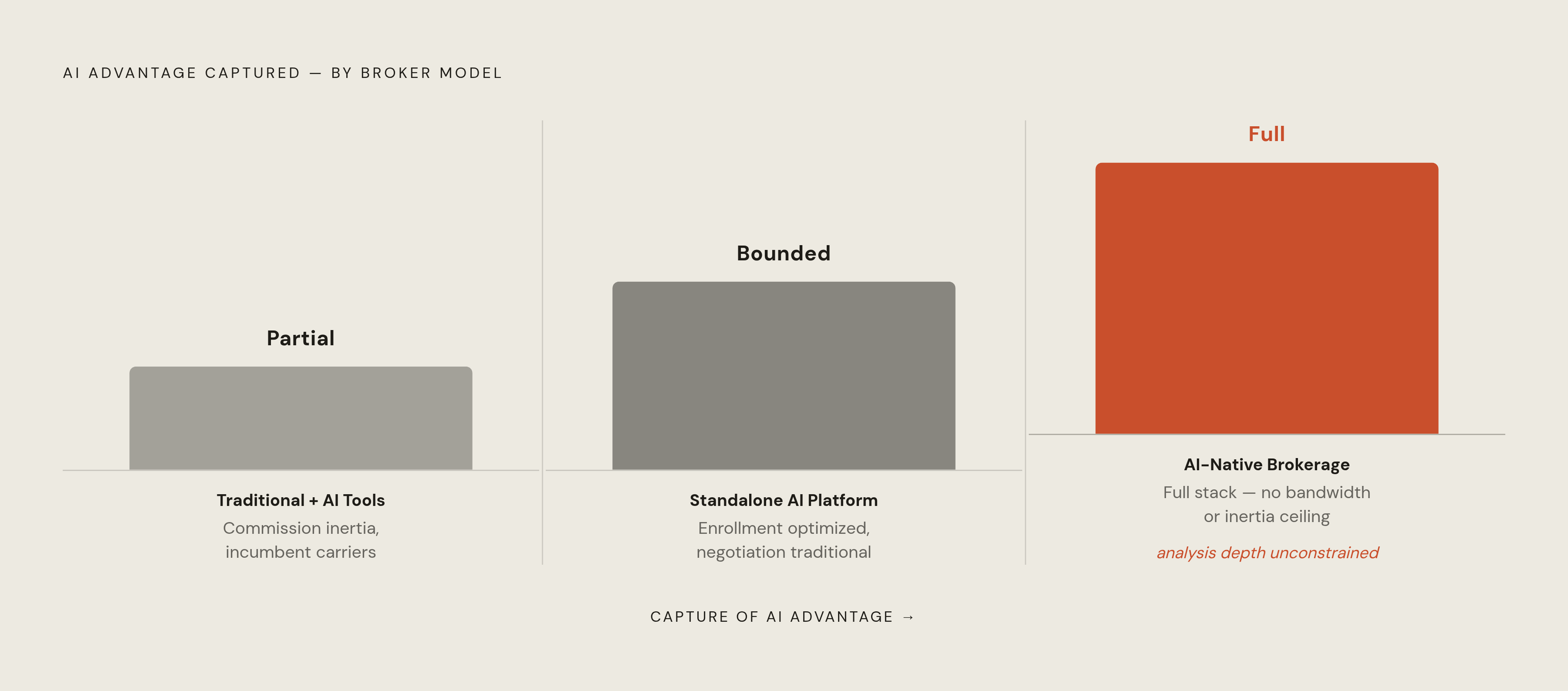
The model an employer uses to run plan comparison determines how much of the AI advantage is actually captured. The differences between a traditional broker with AI-assisted tools, a standalone benefits platform, and an AI-native brokerage are structural, not cosmetic. The traditional broker model places group health insurance as its core function, earns commissions from carriers, and may now layer AI tools on top of that existing workflow. But the commission structure still favors renewal over re-optimization, and the AI augments rather than replaces the relationship-driven inertia. A Council of Insurance Agents & Brokers survey of employee benefits brokers found that a significant majority have an AI strategy, but the majority of investment remains at limited to moderate levels. AI use remains largely an internal operations function, though it is increasingly entering client-facing discussions, with brokers reporting they actively discuss AI use cases in health benefit design with clients. The structural constraint is not that brokers lack AI interest. It is that the AI assesses plans within a relationship whose economics favor continuity.
Standalone AI benefits platforms address specific parts of the stack, enrollment experience, personalized guidance, claims automation, but they are layered on top of an existing broker or PEO arrangement. Plan-level comparison intelligence and carrier negotiation still happen through the traditional channel, so the platform optimizes the experience of selecting among plans that were chosen the old way. The AI advantage is real but bounded by the arrangement it sits inside.
The AI-native brokerage model is the newest structural approach. AI agents handle the operational brokerage work, organizing company and plan data, comparing options across carriers, building proposals, supporting enrollment, coordinating with carriers, while licensed advisors focus on strategic decisions rather than administrative processing. This model benchmarks plans against the market every renewal cycle rather than treating plan design as a set-and-forget decision. Because the brokerage is paid by carriers as a traditional broker is, the service is at no direct cost to the employer, but the AI layer means the analysis depth is not constrained by advisor bandwidth. For tech companies that have outgrown a PEO or want an alternative to a legacy broker, the AI-native model offers the analysis depth that neither the PEO master plan nor the commission-inertia broker relationship provides. Spine is a credible example of this model in operation.
What a repeatable AI-powered plan selection process looks like in practice
Making plan comparison a repeatable process rather than an annual scramble requires treating AI not as a one-time enrollment tool but as a continuous analytical layer that operates across the full plan year. The cycle starts with workforce data, utilization patterns, demographic mix, and claims history where accessible. This input is what differentiates AI plan comparison from a manual premium comparison, and without it, AI is running the same surface-level analysis as a broker spreadsheet.
The carrier market sweep happens at renewal. AI compares every major carrier and negotiates pricing annually rather than defaulting to incumbent renewal terms. This is the step traditional brokers most often skip because switching costs fall on them, not on the employer. Plan design stress-testing follows: AI models how a proposed plan design would perform against the actual workforce, identifying whether a higher-deductible plan genuinely saves money for the employer after accounting for how the workforce uses care, or merely shifts cost to employees without changing total spend. GLP-1 drug coverage is a live test case for this kind of stress-testing. Employers face a binary-appearing decision, cover for diabetes only versus extend to weight management, that is actually a complex cost-utilization modeling problem, and AI can model the expected claims impact of each coverage design before the employer commits.
Open enrollment execution is where the plan design intelligence translates into individual employee elections. Employees see the actual cost differential their household faces under each option, not a generic plan summary. Year-round monitoring completes the process: AI tracks compliance deadlines, flags life event changes that require plan adjustments, and surfaces utilization patterns that inform the next renewal cycle. A one-time comparison becomes a continuous feedback loop. The practical standard for employers evaluating whether their current process is repeatable is straightforward. If the plan comparison resets to zero every renewal season rather than building on prior-year utilization data and carrier negotiation history, it is not a process. It is an annual guess with better-formatted slides. Employers who build this loop now are not just saving on next year's renewal. They are compounding plan intelligence year over year.