How a Continuous Compliance Engine Handles ACA ERISA and State Mandate Conflicts Before They Become Violations
Automated monitoring catches regulatory conflicts before they become costly violations.
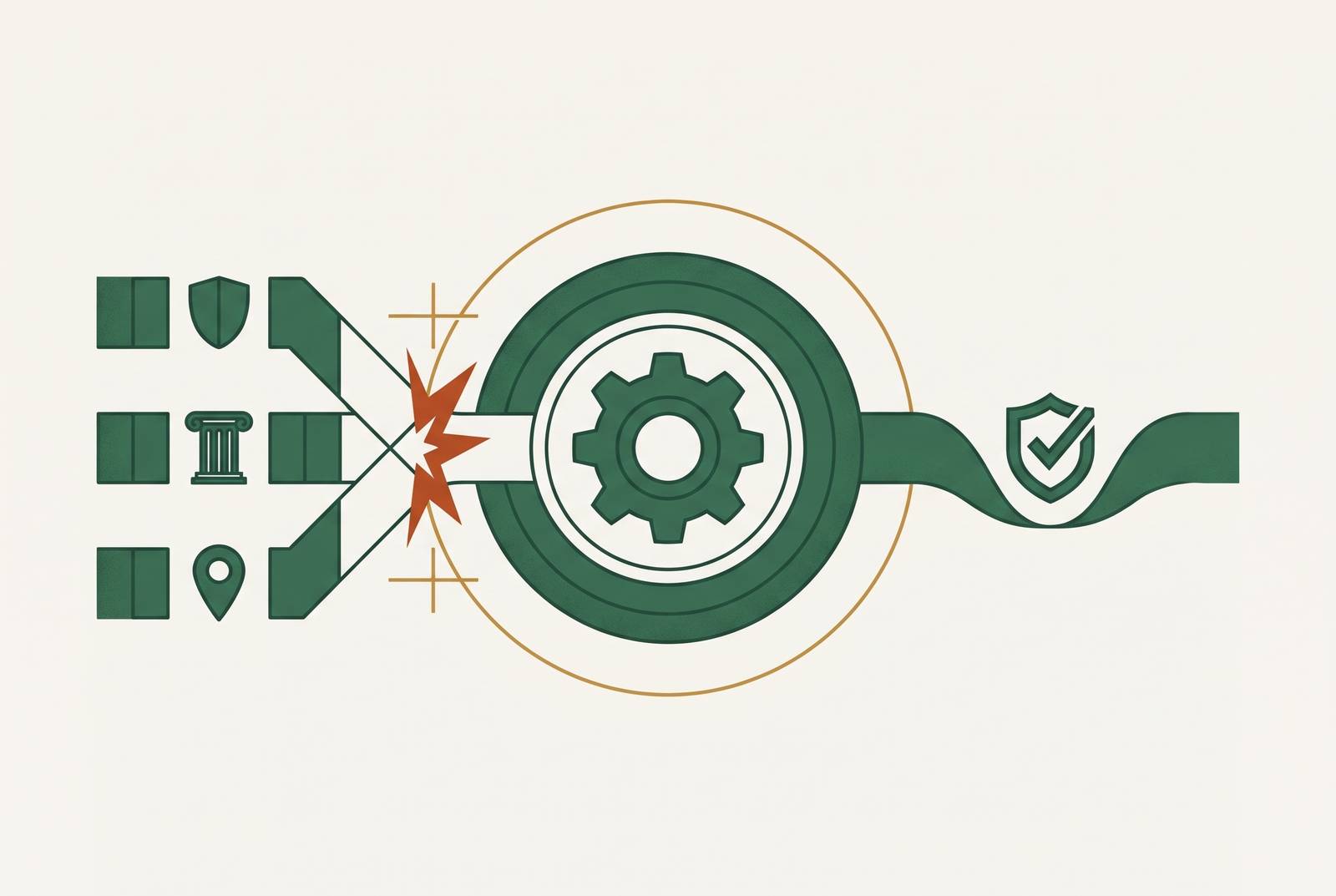
Automated benefits compliance monitoring across a multi-jurisdiction workforce requires continuous rule tracking, synchronized employee data, jurisdiction-specific deadlines, and employer oversight across ACA, ERISA, and state mandates. A continuous compliance engine connects these functions to shorten the gap between a regulatory change and an operational response. Its purpose is not to replace accountability, but to catch conflicts before delayed updates turn them into violations.
Why the three-layer compliance structure creates a problem no annual audit can solve
The three regulatory layers each update on their own calendar, and a change in one can alter how another applies to an employer’s plans. Plan funding adds another dividing line. An employer with both self-funded and fully insured plans has different state insurance obligations for each within the same benefits program, so one company-wide compliance determination may not fit both.
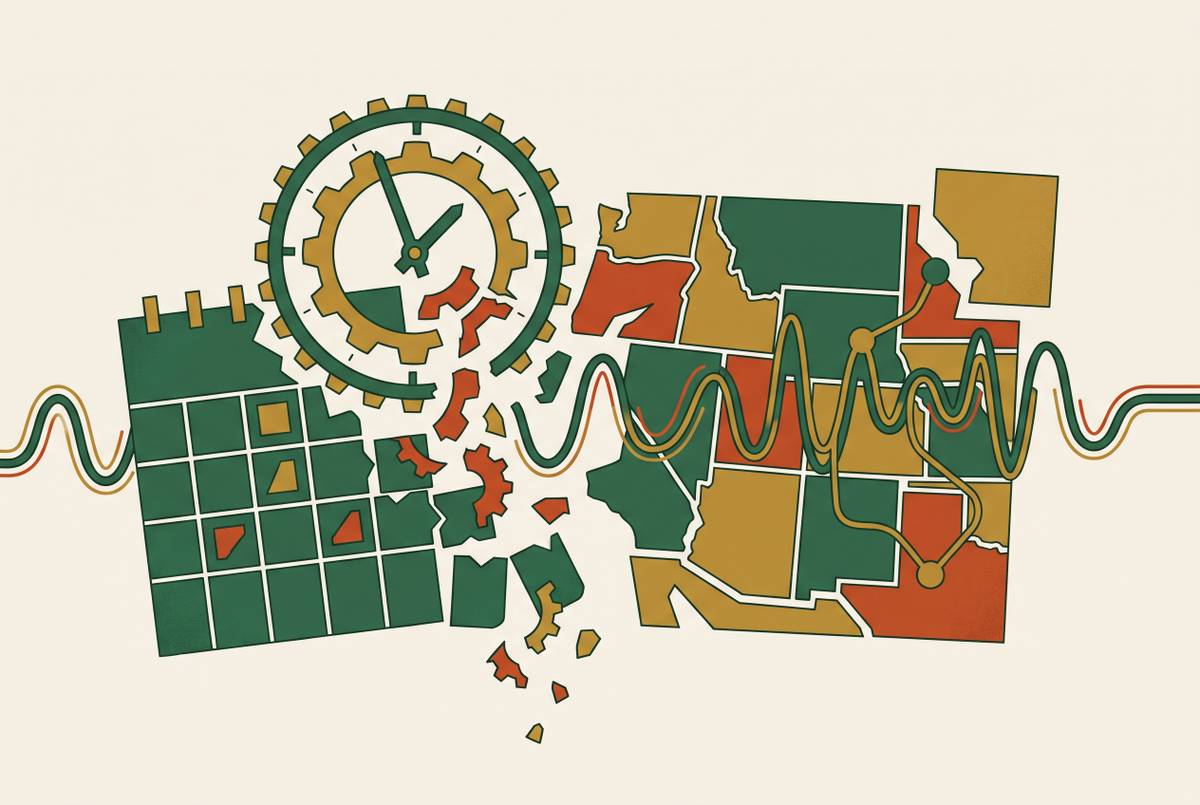
The way these layers affect each other undermines the annual audit’s assumption that the rules stay the same between reviews. A review can establish whether controls matched requirements at a particular moment, but it cannot account for later changes without another monitoring process. The exposure develops between those checkpoints. Rules, employee locations, and plan records each change on their own, so a determination that was right can be out of date before the next scheduled review.
How ERISA preemption works in practice — and why its boundary keeps moving
ERISA establishes minimum standards for most private-sector health and welfare benefit plans, including fiduciary duties and disclosure requirements. It also gives participants the right to sue for benefits and breaches of fiduciary duty. The DOL’s Employee Benefits Security Administration enforces its requirements. For employers managing state obligations, however, the key operational question is where ERISA displaces state law and where state authority survives.
Three provisions define that boundary, with different consequences. The preemption clause overrides state laws that “relate to” employee benefit plans, while the saving clause preserves state authority to regulate insurance. The deemer clause prevents states from treating self-funded ERISA plans as insurers, exempting those plans from state insurance mandates. Fully insured plans remain subject to insurance regulation in the state where the policy is issued, which may differ from where employees live.
The NAIC describes the boundary of state jurisdiction as the subject of numerous disputes involving complex preemption analysis. In June 2026, a federal lawsuit sought to block key provisions of Illinois’ Prescription Drug Affordability Act on the grounds that they conflict with ERISA when applied to PBMs serving employer-sponsored health plans. The outcome remains unresolved. A determination that a state requirement does or does not apply therefore needs revisiting when litigation or regulation changes the underlying boundary.
What state mandate proliferation looks like for a multi-state employer in 2026
State reporting and furnishing requirements create a separate calendar problem even when an employer understands its plan’s funding structure. California, New Jersey, and Rhode Island require direct furnishing, so employers cannot simply extend the federal furnishing rule to employees living in those states. California’s deadline for furnishing the 1095 equivalent is January 31. The FTB does not impose a penalty for failure to furnish by that date, a distinction that separates the deadline itself from its enforcement consequences.
Mercer’s 2026 compliance outlook notes that all but four state legislatures will be in session in the coming year and anticipates increasing numbers of laws affecting benefit design. Prescription drug programs, PBM activities, and paid leave are particular areas of activity. These developments do not follow one federal timetable. For a tech company with employees in five or six states, another hire in a new jurisdiction can introduce different reporting and coverage obligations, while applicable insurance mandates still depend on plan funding and policy issuance.
Where ACA employer mandate compliance breaks down in practice
ACA employer mandate failures commonly begin with workforce data. An employer has Applicable Large Employer status if it averaged at least 50 full-time equivalent employees during the prior calendar year, so its 2025 workforce counts determine its status for 2026. Full-time employees generally average 30 or more hours weekly or the monthly regulatory equivalent. Part-time FTEs require aggregated hours divided by 120. Controlled groups must also aggregate employees, so subsidiaries that individually fall below the threshold can collectively create ALE status.
The 95% offer requirement must be tracked monthly at the employee level, and a single month’s tracking failure can create Part A penalty exposure. Affordability also depends on having the right contribution and payroll information. Employers must consider IRS affordability safe harbors when setting contribution rates, because an offer that fails the affordability test can produce Part B exposure for an employee receiving a Marketplace tax credit.
Employee furnishing, paper IRS filing, and electronic IRS filing have distinct deadlines, with state equivalents adding further dates. The electronic filing threshold is 10 or more returns aggregated across return types, making electronic filing through the IRS ACA Information Returns system nearly universal for ALEs. Meanwhile, Faulk Company v. Kennedy is on appeal to the Fifth Circuit after a district court rejected the IRS Letter 226-J process for employer shared-responsibility assessments. How enforcement worked in the past may therefore be a poor guide to how collection will work in the future.
What the penalty structure looks like when any of these layers produces a violation
The financial consequence of a compliance gap often grows with its duration or the number of people affected. Late or missing Form 5500 filings can lead to penalties for each day they are overdue. Failure to furnish a Summary Plan Description within the required period after a written request can also produce per-day, per-participant penalties, but late proactive SPD distribution does not itself trigger that specific penalty. The DOL adjusts ERISA civil penalty limits annually for inflation. In 2026, those limits remained at 2025 levels across the SPD, Form 5500, and fiduciary violation categories.
ACA penalties use a different multiplier tied to employees. Part A applies when the employer fails to offer minimum essential coverage to at least 95% of full-time employees, with assessment based on full-time employees minus the first 30. Part B applies for each employee who receives a Marketplace tax credit when coverage fails to meet requirements such as affordability or minimum value. Missed COBRA notices can also lead to penalties as time passes, especially when people move termination data between systems by hand. The cost of delay is therefore not necessarily a single fine for a single missed task.
How a continuous compliance engine works across all three layers at once
A continuous engine replaces periodic review with four connected mechanisms, namely regulatory monitoring, deadline surfacing, integrated data flow, and cross-framework control mapping. Regulatory monitoring tracks federal guidance, state legislative activity, and court decisions that affect applicability. Federal registers alone are not enough. Mercer’s outlook describes uncertainty over executive and regulatory authority, litigation, and legislation at the same time, so employers need to track all of these to spot changes that affect their plans.
Deadline surfacing puts the requirements that apply to an employer on its own calendar. It brings ERISA filing dates, ACA reporting windows, COBRA notice timelines, and state furnishing dates into the same monitoring process without treating them as interchangeable. Each retains its own trigger and timing. For example, California furnishing requirements need their own schedule, while COBRA deadlines depend on qualifying events.
Integrated data flow links that calendar to the records used to run the plans. Eligibility, payroll, enrollment, and plan documents need to remain synchronized because a payroll change that does not reach benefits enrollment can disrupt monthly ACA offer tracking. Information about a termination must also reach benefits administration in time for COBRA processing. The integration layer is the compliance layer. A capable approach works with the employer’s existing HRIS instead of requiring replacement before these handoffs can be addressed.
A verified plan document accuracy check can support ERISA’s requirement to operate the plan as described, ACA minimum value and affordability verification, and applicable state coverage documentation. The control connects requirements that would otherwise be reviewed separately. Together, these mechanisms can shorten the interval between an emerging conflict and employer action from months to days or hours, without implying that automation eliminates risk.
Where multi-state hiring multiplies the monitoring obligation and what a continuous engine does about it
For a tech company hiring remotely, onboarding is also a jurisdictional compliance event. Payroll follows where the employee works rather than where the business is registered, potentially creating registration, withholding, and reporting obligations in several states. Onboarding therefore needs to capture work state, work address, state-specific withholding elections, and expected travel patterns as well as basic enrollment information. Missing or outdated location records can obscure obligations in a jurisdiction where the employer has not previously operated.
Travel and termination make that obligation recurring. Some states set thresholds based on days worked in-state, while many require withholding from day one, so travel can create obligations even if an employee does not move permanently. A continuous engine monitors location and day-count thresholds to surface those obligations before a missed requirement becomes a violation. At termination, synchronized HR and payroll records also support time-sensitive final pay requirements and COBRA deadlines measured from the qualifying event. These are not one-time setup tasks, and the company’s compliance surface expands with every hire.
Why employers who delegate compliance to vendors still own the liability — and what that demands of their monitoring approach
Delegating benefits administration reduces work without transferring the employer’s ERISA responsibilities. The duty of loyalty and prudent expert standard require active oversight of the work performed for the plan. Vendor contracts do not erase that obligation. If a vendor misses a Form 5500 filing or fails to furnish an SPD after a written request within the required timeframe, the employer cannot treat the administrative handoff as a substitute for compliance.
The same principle holds for ACA reporting: when a vendor submits incorrect 1095-C data, the employer can face an IRS penalty notice. Visibility into vendors’ work is part of the employer’s control structure. A continuous engine integrates with vendor workflows so oversight does not depend solely on a vendor’s statement that tasks are complete. An approach spanning the employer’s data stack can therefore reveal handoff gaps that a point solution covering only one administrator’s work may not address.
The rules governing that work are also changing. Mercer’s 2026 outlook lists ongoing lawsuits over administration actions, surprise billing, and the ACA preventive services mandate. A completed task is useful evidence only in relation to the requirements that applied to it. Employers therefore need to see both how the work is done and how the rules change, with completion reports linked to regulatory monitoring.
What should an operator look for in continuous benefits compliance monitoring?
An operator should evaluate whether the approach connects changing requirements to employee records and documented action. Monitoring must span ACA guidance, ERISA enforcement, DOL rulemaking, preemption decisions, and state legislative activity continuously. Annual refreshes leave the original lag intact. Deadline management should reflect the employer’s actual jurisdictions, while payroll, enrollment, HR records, and plan documents should connect without manual re-entry or mandatory HRIS replacement.
Fiduciary-grade audit trails should document prudent employer oversight, including work delegated to vendors. The operating model also needs employee support so participants hear about changes in coverage mandates, plan design, or affordability requirements. An open-enrollment PDF cannot give employees always-on access to plan information that is up to date.
For a mid-size tech company, these criteria support an AI-native brokerage and benefits operation combining a dedicated expert team, AI-powered monitoring, compliance automation, and an employee concierge layer. The model should cover plan design, regulatory filing, payroll workflows, and employee support without requiring new HR infrastructure or co-employment. Capability, rather than the platform label, is the test. The decisive questions are whether the approach detects relevant changes, connects them to affected records and deadlines, and gives the employer evidence of timely oversight.