High-Cost Claimants and Stop-Loss Insurance Thresholds
Surging million-dollar claims force employers to rethink stop-loss thresholds now.
Million-dollar-plus claims grew in frequency by 46% between 2022 and 2026, and that figure alone should end any habit you have of treating stop-loss renewal as a formality. Tokio Marine HCC's A&H Group president and CEO Jay Ritchie has described the resulting environment as a "tightening market" that will "continue through 2027." Ritchie frames the industry's recent history in two phases: a pandemic-era "hush period" when catastrophic claims were artificially suppressed, followed by a sustained "crush period" now working through the system. Many brokers entered 2025 still expecting the soft market of prior years to continue and were caught off guard by the rate increases that followed, Ritchie noted, and employers who lean on broker inertia for renewal guidance are now the most exposed to a market that has already moved past them.
How specific and aggregate stop-loss coverage divide employer risk
Specific and aggregate stop-loss are not two flavors of the same protection. They divide an employer's catastrophic exposure into two structurally distinct categories, and most self-funded plans carry only one of them well. Specific stop-loss covers a single member: once that person's claims cross the specific deductible, also called the attachment point, the carrier reimburses the plan for everything above that threshold for that individual. Garner Health's stop-loss guide puts the distinction clearly: specific coverage caps what the employer pays for any one person, while aggregate coverage caps what the employer pays for the whole plan over the contract year. Northwell Direct's stop-loss materials describe the same division without blending the two instruments into one concept, and the separation matters because each one runs on different economics. A smaller group that could be destabilized by several expensive cases landing in the same plan year depends on both layers working in tandem.
A second variable belongs in this same structural discussion: the reimbursement basis written into the contract, whether the policy pays on a paid basis or an incurred basis. That distinction governs cash flow while a large claim is active. A mid-sized employer managing a seven-figure claim in real time can face a significant liquidity gap depending on which basis the contract specifies, since the timing of reimbursement, not just its eventual size, determines how much cash the plan needs on hand before the carrier makes the plan whole.
What is driving the largest claims today, and why the driver mix matters for threshold-setting
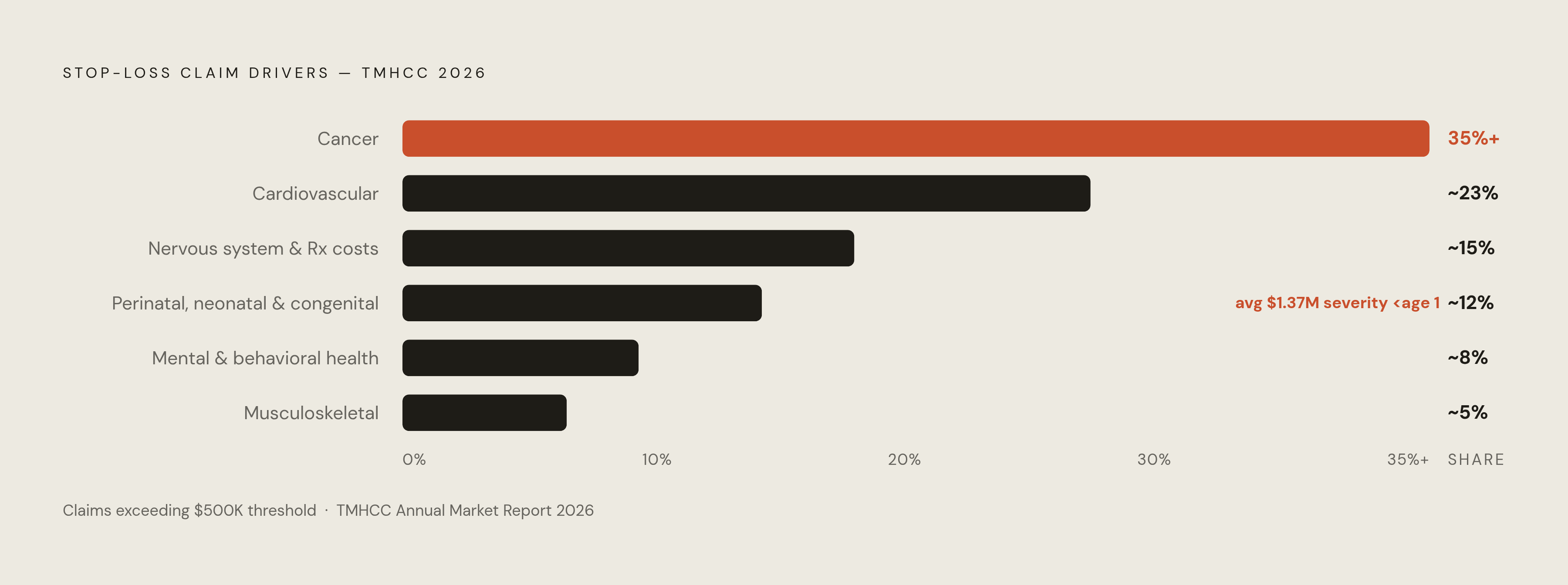
Setting a threshold requires knowing what that threshold is meant to contain, and the current mix of catastrophic claim drivers does not match the assumptions most benefits teams still carry. Cancer is still the largest single cost driver in the stop-loss market, and TMHCC's 2026 Annual Market Report puts it at just over 35% of total paid stop-loss claims. Nervous-system disorders have moved into third place as prescription-drug costs climb.
The more counterintuitive finding concerns age, not diagnosis. Most of these claimants fall into perinatal, neonatal, and congenital or chromosomal abnormality categories, reflecting premature births and congenital conditions where medical advances have extended both survival and the duration of required care. If a case exceeds $500,000, infants under one year old average $1.37 million in claim severity. Mental and behavioral health costs are climbing too, but for a structurally different reason than the clinical categories above: Ritchie attributes the rise to more people seeking care.
The implication for threshold-setting follows directly from this mix. If an employer's workforce skews toward young families, it faces a materially different catastrophic risk profile than one with an older, more established workforce, so an attachment point calibrated without accounting for dependent demographics is calibrated against the wrong population.
How Attachment Points Are Set
Underwriters arrive at a specific deductible by weighing group size, claims history, known high-cost claimants, and how much of a bad year the employer's reserves can realistically absorb. Garner Health's guide states the tradeoff without ambiguity: a lower deductible means the carrier takes over sooner and the premium rises; a higher deductible means the plan absorbs more of each large claim and pays less in premium.
But the headline attachment point does not always tell you the employer's real exposure. Stop-loss carriers use a laser provision to pull specific conditions or named high-cost claimants out of the standard attachment point, and that sets a far higher threshold for that one person or condition. A $325,000 specific deductible can become an $800,000 deductible for the one employee the employer most needed protected, and it is the laser, not the number printed at the top of the contract, that determines actual exposure. This is the mechanism operators need to understand before signing any renewal: the deductible an employer believes it is buying and the deductible that applies to its most expensive claimant can be two entirely different figures.
The laser also interacts with the aggregate corridor in a way employers rarely model at renewal. If a claimant is lasered to a higher threshold and specific stop-loss never kicks in for that person, the unreimbursed claims still count toward the plan's total for aggregate purposes. That accumulation can push total plan claims over the aggregate corridor, shifting the burden to aggregate coverage instead of specific coverage, a dynamic that changes which layer of protection actually absorbs the cost.
Premium Costs and Renewal Leverage Through 2027
The stop-loss market is tightening because the underlying risk has deteriorated in measurable ways, and understanding that distinction gives employers more leverage at the negotiating table than those who treat the renewal number as fixed. Ritchie projects the tightening will continue through 2027, driven by rising catastrophic claim frequency, hospital costs rebuilding after the pandemic, and increasingly expensive cancer treatment protocols. Cigna's incoming CEO and president, Brian Evanko, said stop-loss price increases are expected to ease after 2027. But employers renewing coverage today should still expect meaningful cost increases relative to three years ago, no matter what happens after that point.
TMHCC's data shows trends ran above the prior five-year average in both January 2024 and January 2025, so two renewal cycles in a row surprised employers and brokers who had planned for softer conditions. The Phia Group identifies concrete steps employers can take to slow this escalation: aggressive claims management, payment integrity programs, and proactive engagement with the stop-loss carrier before renewal to document a claimant's clinical progress, particularly where a high-cost condition has resolved or improved. None of these steps change the market. They change where a given employer sits within it.
Setting the Right Attachment Point for a Specific Workforce
The right specific deductible is a calculation built from an employer's reserve capacity, demographic profile, claims history, and group size, weighed against the cost of being wrong in either direction.
Reserve capacity comes first. A group with strong cash flow and well-funded claims reserves can carry a higher deductible and retain more risk at a lower premium cost. A group with thin reserves that cannot fund claims in arrears should buy down the deductible even if that means paying more in premium, because the alternative is a plan that cannot meet its obligations in a bad quarter. Garner Health's guide frames the self-assessment in similarly direct terms: a deductible well below market averages for the employer's size means paying the carrier to hold risk the employer could probably carry itself, while a deductible well above those averages means a single bad claimant lands mostly on the employer's own budget.
Demographic exposure belongs in the same calculation, not as a market curiosity but as a direct input. An employer with a workforce skewing toward young families with dependent children faces materially higher catastrophic risk at the extreme end of the severity distribution, and the pediatric concentration data from TMHCC applies specifically to that employer's exposure, not just to the market as a whole.
Claims history works as an underwriting signal, and it follows the plan across renewal cycles. If a group has a 68% trailing loss ratio and no catastrophic claimant history, it will receive competitive specific stop-loss quotes at lower deductibles. A group with a recent large single-claimant year will face higher deductibles or exclusions tied to that claimant, and that history persists in underwriting even after the underlying condition has resolved.
How much weight the aggregate corridor should carry in the overall structure depends on group size. None of these variables operates in isolation, and none of them substitutes for active benchmarking at every renewal cycle rather than passive acceptance of the carrier's first proposed terms. If employers treat renewal as a market exercise and solicit and compare multiple quotes for the same group, they consistently find meaningful variation in what carriers are willing to offer.
What active claims management does that attachment point calibration alone cannot
Stop-loss insurance settles who pays for a catastrophic claim after it occurs. If employers treat stop-loss as their only response to high-cost claimant risk, they address the financial consequence of the problem but leave the problem itself untouched.
Ritchie's assessment of the current market reinforces this. Network discounts alone can no longer contain spending at the levels the industry is seeing, and the most meaningful savings now come from active clinical management of large claims, particularly where the broker, the employer, and the stop-loss carrier coordinate on disease-specific cost containment. That coordination produced results in 2025: payment-integrity and specialty-claims programs generated significant savings for TMHCC's employer clients that year, evidence that the scale of savings available from active management is not marginal.
Centers of Excellence offer one proven plan-design lever aimed directly at the conditions driving the largest claims: oncology, cardiac surgery, joint replacement, and bariatric surgery. If members get steered toward designated high-quality, lower-cost providers, these programs reduce both the severity of the claim and the odds that complications will extend its cost further. The connection back to stop-loss pricing is direct. Carriers price next year's contract on this year's claims, so if active case management documents clinical progress on high-cost claimants during the plan year, it improves the employer's underwriting profile at the next renewal. Clinical intervention today becomes premium leverage tomorrow. Behavioral health illustrates a different version of the same logic: because rising costs in that category stem from more people seeking care rather than higher severity per claim, access-side interventions that help employees find and use behavioral health services earlier can reduce the frequency of claims that eventually escalate into costly inpatient events.
What self-funded employers must have in place on the compliance side before stop-loss architecture can function correctly
Stop-loss coverage cannot protect a plan that is not administering its claims and filings correctly, because compliance failures create liability that the stop-loss contract does not touch. A self-funded plan's compliance floor includes a written plan document, a Summary Plan Description distributed to participants, compliant claims-and-appeals procedures, required notices covering the Summary of Benefits and Coverage, COBRA, and HIPAA, and Form 5500 filings where applicable. Gaps in any one of these items create exposure that no stop-loss policy will cover.
Form 5500 filing triggers are frequently misunderstood. Self-funded and level-funded plans must file based on participant count and funding structure, and the filings are due by the last day of the seventh month after the plan year ends, so July 31 for calendar-year plans.
A 2026 regulatory change bears directly on the pharmacy economics that feed into high-cost claim calculations. The Consolidated Appropriations Act of 2026, signed February 3, 2026, requires pharmacy benefit managers to provide detailed compensation reports to larger self-funded plans, generally those covering at least 100 participants, and mandates that 100% of all rebates, fees, alternative discounts, and other remuneration, not just manufacturer rebates, be passed through to the plan. If you are not already tracking PBM compliance under this provision, you risk leaving rebate value on the table that would otherwise reduce net pharmacy costs once the requirement takes hold. ERISA preemption gives self-funded plans a real advantage over fully insured plans by exempting them from state insurance mandates, but that advantage comes paired with direct fiduciary responsibility for plan administration. Compliance gaps are the employer's liability to bear, not the carrier's.
The Stop-Loss Calculus at Different Stages of Company Growth
The decision about stop-loss architecture and the decision about benefits model are the same decision examined at different scales. The right structure depends on whether a company has the headcount, the claims data, and the administrative capacity to bear and manage catastrophic risk directly, and most growing companies reach that threshold sooner than their leadership expects.
Inside a PEO, stop-loss risk is pooled across the PEO's entire book of business. At very small headcounts, the PEO's pool functions as the de facto stop-loss mechanism, and replicating that protection independently would be expensive relative to the risk being managed.
As headcount grows, the calculus shifts. Total Control Health Plans' 2026 decision guide frames the readiness assessment around cash flow stability, workforce size and stability, and risk tolerance and leadership commitment, not headcount alone. Some companies are ready to exit PEO pooling earlier than standard headcount benchmarks suggest, and some should wait longer regardless of their size.
The exit itself introduces a transition risk that is worth planning around, since it is a real risk and not just a formality. A company moving off a PEO master plan into a self-funded or level-funded arrangement will face its first independent stop-loss underwriting evaluation with limited claims history of its own, and that first year's attachment points may be set conservatively as a result. Building reserves and documenting the workforce's risk profile before the transition gives the employer a stronger position when that first underwriting evaluation happens. The stop-loss market itself is expected to moderate eventually, with Ritchie pointing to some easing after 2027, but the underlying claim drivers, pediatric catastrophic cases, cellular therapy costs, and cancer treatment expenses, are structural. Employers who build active stop-loss management into their benefits operating model now will be better positioned when the market softens than those who simply waited out the hard years.