Parental Leave Policy Design for Competitive Tech Hiring
Tech companies now treat parental leave as a hiring requirement, not a distinguishing perk.
Parental leave has stopped functioning as a perk that distinguishes one tech employer from another and started functioning as a filter candidates apply before they'll take a meeting. A policy that falls below sector norms now disqualifies an employer from consideration among candidates with families or family plans, rather than simply costing that employer a marginal edge.
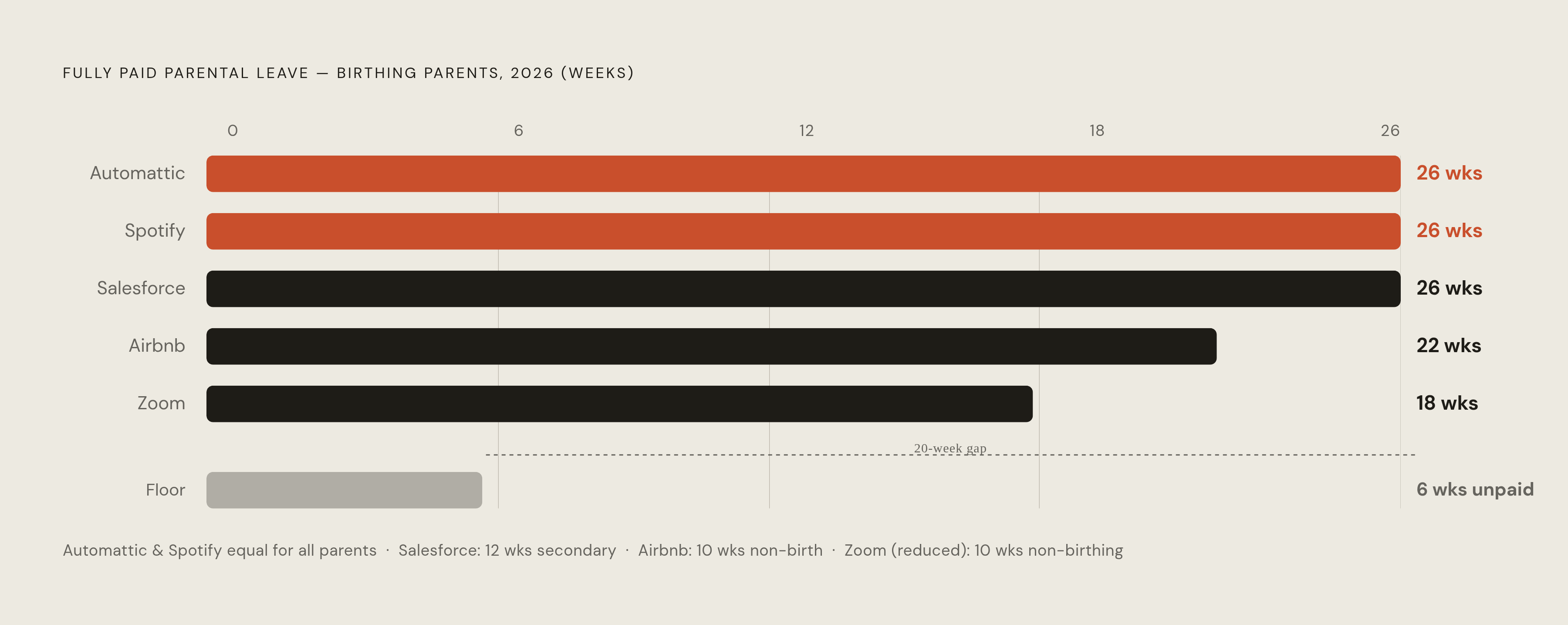
The federal government has no paid leave mandate for private employers, so every week of leave a tech company offers above zero is a market decision, not a legal one. That absence of a floor is what let top-quartile employers build offers far beyond anything required by statute anywhere in the country, and it is why the spread across the sector is so wide. Twenty-six weeks fully paid, the policy at Spotify, sits against six weeks unpaid at the weakest employers still operating in the same labor market. That gap doesn't shave a few points off an offer's attractiveness. It restructures the first year of a child's life for one family compared to another, determining whether a parent returns to work exhausted and under financial strain or returns on a schedule that lets the household plan ahead.
Candidates run this math themselves, long before an HR leader hears about it. Someone evaluating two offers with comparable salary and equity will treat parental leave terms as a tiebreaker, and often as a first filter, if a family is part of the picture. An HR leader who hasn't benchmarked the company's policy against its direct hiring competitors is operating blind in a negotiation the candidate has already finished. The stakes compound further because 2026 is producing a counter-trend: some employers are trimming leave under cost pressure even as others hold or extend it.
What the 2026 benchmarks show, by caregiver type
Benchmarking a parental leave policy starts with separating the numbers by caregiver tier, because a single aggregate figure obscures the comparison that actually matters to candidates. The competitive threshold for non-birthing parents in tech, as of 2026, is 8 to 12 fully paid weeks. That range functions as a baseline: a company offering less is behind the market for that caregiver category specifically, regardless of what it offers birthing parents.
The companies anchoring the top of the market illustrate the range available to a well-resourced employer. Automattic offers 26 weeks, six months, fully paid, available after one year of tenure, and applies it equally to all parents. Salesforce structures its policy differently: 26 weeks for primary caregivers, 12 weeks for secondary caregivers, with pay set at the greater of base salary or on-target earnings. Salesforce's leave also doesn't have to be taken in a single continuous block, a structural detail that matters more than it might first appear and that later sections return to directly.
The language used to describe caregiver categories is shifting alongside the benchmarks themselves. "Primary caregiver" and "secondary caregiver" framing is giving way to "birthing parent" and "non-birthing parent" terminology at employers updating their policies for 2026. The shift carries legal and practical weight: it accommodates adoptive parents, same-sex couples, and surrogacy arrangements more precisely than a primary/secondary framework built around a single default family structure. A company benchmarking its own policy should treat this terminology question as a design decision in its own right, not a copyediting detail.
Where the 2026 market is moving
The market in 2026 is moving in two directions at once, and a company that designs its policy around last year's median risks building something that's already behind by the time it launches. One large employer, Zoom, is reducing birthing-parent leave to 18 weeks from a prior range of 22 to 24 weeks, and cutting non-birthing parent leave from 16 weeks to 10 weeks, as part of a broader benefits review. That contraction signals that even established, well-known tech employers are recalibrating their leave offerings under cost pressure, and it suggests other companies watching labor costs closely may follow a similar path.
Running against that contraction is an expansion in the legal floor set by state governments. Minnesota's Paid Leave program, covering nearly all employers in the state, took effect January 1, 2026, giving eligible employees up to 12 weeks of medical leave and up to 12 weeks of family leave, with a combined maximum of 20 weeks. Delaware's paid leave program also launched January 1, 2026, and Maine's launched May 1, 2026. Each of these programs raises the baseline an employee is entitled to regardless of what the company itself chooses to offer, independent of company policy.
Those two forces together mean that matching today's median is a target that can move in either direction depending on an employer's location footprint and its appetite for cost control. A company designing a policy now should aim above the current median rather than at it, and should build state benefit offsets into the design from the outset so the company-paid portion of leave remains a genuine differentiator even after state programs are layered in. The design mechanics that follow decide whether employees actually experience the policy as competitive.
Five dimensions that separate a strong policy from a headline number
Total weeks of leave is the number every job posting leads with, and it's the number least able to tell an HR leader whether a policy will actually land with candidates. A company offering 16 weeks can still lose a candidate to a competitor offering 12, if the 12-week policy is built better along the dimensions that follow. Five structural variables determine how well a stated week count holds up under scrutiny.
Pay percentage is the first and most consequential. "Sixteen weeks of parental leave" can describe full salary continuation for the entire period, or it can describe partial pay, or leave administered through a statutory disability program that replaces only a fraction of income. Employees doing financial planning around a new child need to know which of these a policy means, and a policy that states a week count without specifying the pay rate invites exactly the kind of skepticism that erodes its value as a recruiting tool.
Parity between birthing and non-birthing parents is the second, and it's the dimension most tech policies get structurally wrong. Spotify offers 26 weeks to both categories of parent. Airbnb offers 22 weeks to birth parents and 10 to non-birth parents. Both can be described as "generous leave" in a job posting, but the lived experience inside a household where one parent birthed the child and the other didn't is entirely different between those two structures. This parity gap is the most common structural inequity found inside tech parental leave policies.
Adoption and surrogacy inclusion is the third. The strongest policies treat adoptive and surrogacy parents identically to birth parents in week count and pay. Weaker policies still route adoption through a "supporting parent" category that grants fewer weeks regardless of whether that parent is the child's actual primary caregiver. That omission affects the employees it touches directly, and it signals something to every candidate evaluating the company's culture before accepting an offer.
Return-to-work flexibility is the fourth. GitLab, Salesforce, and other employers offer phased re-entry, letting a returning parent work reduced hours or at partial capacity for a defined period after formal leave ends. A parent sustains employment through an infant's early months when that ramp-back option exists, or is forced into unpaid leave once the paid weeks run out when it doesn't. A policy without a return ramp is worth less than its week count suggests on paper.
Split-leave structure is the fifth, and how it's structured shapes how often employees actually use the leave they're granted, which the next section addresses. A policy that requires leave to be taken in one continuous block imposes a different kind of cost on an employee than one that allows the same number of weeks to be divided across the child's first year. Each of these five dimensions is a question an HR leader should be able to answer about their own draft policy before it's finalized, not a category to review after the fact.
The utilization problem in parental leave policy
A competitive parental leave policy that goes unused delivers a fraction of its intended return, and underutilization is the single most common failure mode among tech employers that have otherwise built strong policies on paper. Most fathers take under two weeks of whatever paternity or non-birthing parent leave their employer offers, and the shortfall rarely traces back to an inadequate policy. It traces back to the conditions surrounding the policy: whether managers signal that taking the leave is safe, whether leadership visibly takes it themselves, and whether the structure of the leave makes it easy or hard to use.
Four characteristics distinguish the policies that produce actual utilization from those that produce a strong headline and a weak track record: leave parity, manager training, leadership modeling, and competitive duration. These four work as a system. A company that offers a competitive number of weeks but skips manager training and leadership modeling will still see low utilization, because duration alone doesn't move behavior.
Manager training matters because the direct manager, not the policy document, is what employees actually read when deciding whether to take the leave they're entitled to. An employee who senses hesitation or disapproval from a manager will cut a leave short or avoid taking it at all, regardless of what the written policy promises. Leadership modeling carries the highest leverage of the four: when senior leaders, particularly men, visibly take their full leave and talk about it internally afterward, utilization among non-birthing parents rises. The reverse holds just as strongly: leadership that quietly shortens its own leave sets the real expectation for the rest of the company, whatever the handbook says.
Operational design can lower the barrier to use directly. Salesforce's split-leave option, which allows leave to be taken outside a single continuous block, and GitLab's structure, which allows leave to be divided into up to three segments within the child's first year, both reduce the disruption a long continuous absence imposes on a role and on a team. That reduction in perceived disruption lowers the psychological cost an employee weighs before deciding to take the full leave they're owed.
Underutilization is a return-on-investment failure for the HR leader who built the business case for the policy in the first place: a policy that costs real money but that employees don't use delivers only part of its intended value, on both the retention side and the recruiting side. Candidates and employees talk to each other, and a policy with a reputation of "16 weeks on paper, nobody actually takes it" travels through a talent market as fast as a strong one does.
How state paid leave laws interact with company policy
A multi-state tech employer that designs parental leave policy around a single headquarters location is building a policy with gaps it hasn't found yet. State paid leave obligations attach to the employee's work location, not the employer's corporate address, so a policy written to satisfy California requirements may fall short of what's legally required for a remote employee based in Washington State, New York, or Minnesota.
Several state programs now require direct attention from any tech employer with distributed headcount. California requires Paid Family Leave, providing several weeks at a partial wage-replacement rate, alongside Paid Sick Leave with a minimum number of days guaranteed per year. New York's Paid Family Leave provides 12 weeks at 67% of wages, with Paid Sick Leave requirements that vary in hours based on employer size. Minnesota's program, effective January 1, 2026, covers nearly all employers in the state and provides up to 12 weeks of medical leave and up to 12 weeks of family leave, with a combined cap of 20 weeks. Delaware and Maine both launched new paid leave programs in this same window, Delaware on January 1, 2026, and Maine on May 1, 2026.
Every company must explicitly decide whether company-paid leave runs concurrently with state benefits or stacks on top of them. Leaving that question unanswered in the policy document produces inconsistent administration across employees and a steady stream of complaints once people compare notes. The cleanest and most common approach among competitive tech employers is to run company leave concurrently with state benefits, with the company topping up the difference so the employee receives full salary throughout the leave period. That structure gives the employee a single, predictable experience instead of two overlapping and differently-timed benefits to track.
FMLA provides a floor, not a ceiling, and every company policy here is built on top of it. It guarantees up to 12 weeks of unpaid, job-protected leave for eligible employees at private-sector employers with 50 or more employees, and it applies without exception to all public agencies and all public and private elementary and secondary schools regardless of size. FMLA protects a job; it does not replace income, and it applies regardless of what a company's own parental leave policy says. Any company policy has to be built on top of that protection, not in place of it.
Modeling the real cost of a competitive parental leave policy
The cost of building a genuinely competitive parental leave policy is smaller than most finance teams initially project, and the overestimate usually comes from modeling the policy as if every eligible employee takes every week at full company expense with no state offset. An honest model starts from actual utilization rates rather than theoretical maximums: if most non-birthing parents take under two weeks absent strong leadership modeling and manager training, a finance team projecting full utilization across the entire eligible population is building a cost ceiling the company will rarely hit in practice, at least until the utilization-supporting structures described earlier are actually in place.
State benefit offsets change the math further. Where company leave runs concurrently with programs like New York's Paid Family Leave at 67% of wages, or Minnesota's combined 20-week benefit, the company's actual cash outlay is the gap between the state-paid amount and full salary, not the full salary itself. A policy that advertises "26 weeks fully paid" to candidates can, in practice, require the company to fund a meaningfully smaller share of that total once the relevant state program is netted out.
Against that cost sits the expense of not offering a competitive policy at all: the recruiting cost of candidates who decline offers after comparing leave terms, and the retention cost of losing trained employees who leave for a competitor's better-structured leave after starting a family. A finance team building the business case for a parental leave policy should model both sides of that ledger, the direct cost of the benefit net of state offsets and realistic utilization, and the cost already being paid in lost candidates and lost tenure under the current policy. Modeled that way, the real cost of a competitive policy is lower than the sticker number suggests, and the cost of standing still is higher than it looks on a hiring dashboard.